|
Newest Reviews:
New Movies -
The Tunnel
V/H/S
The Tall Man
Mama Africa
Detention
Brake
Ted
Tomboy
Brownian Movement
Last Ride
[Rec]³: Genesis
Hara-Kiri: Death of a Samurai
Indie Game: The Movie
Abraham Lincoln: Vampire Hunter
Old Movies -
Touki Bouki: The Journey of the Hyena
Drums Along the Mohawk
The Chase
The Heiress
Show
People
The Strange Affair of Uncle Harry
Pitfall
Driftwood
Miracle Mile
The Great Flamarion
Dark Habits
Archives -
Recap: 2000,
2001, 2002,
2003, 2004
, 2005, 2006,
2007 , 2008
, 2009 ,
2010 , 2011 ,
2012
All reviews alphabetically
All reviews by star rating
All reviews by release year
Masterpieces
Screening Log
Links
FAQ
E-mail me
HOME
| |
Broken Blossoms
(D.W.
Griffith) 1919
 Tremendously
downbeat, but beautifully stylized, D.W. Griffith’s Broken Blossoms certainly hasn’t aged immaculately. Set mainly in
a London slum, this unabashedly manipulative melodrama tells the story of a
Cheng Huan, young Chinaman who falls in love with Lucy, a fifteen-year-old über-waif
(played memorably by Lillian Gish, who was 23 at the time of filming), with
tragic results. Because the film predominantly deals with racial relations
between the Londoners and the foreigner, things often feel a bit off. For
example, after a touching scene where Cheng nurses Lucy back to health following
a severe beating, she affectionately calls him “Chinky.” Yikes! My
politically correct sensibilities kicked into overdrive at that one (not exactly
an isolated incident here, either), hoping that we were supposed to note the
irony of this girl, faced with the kindness of a singular individual, still
classifying him arbitrarily by his skin color, but the comment slides by
unchecked. That Griffith supposedly made this film partially as a retort to
those who claimed his dubious masterpiece The
Birth of a Nation was racist is a mind-boggling example of how much our
perceptions of such things have changed.
Tremendously
downbeat, but beautifully stylized, D.W. Griffith’s Broken Blossoms certainly hasn’t aged immaculately. Set mainly in
a London slum, this unabashedly manipulative melodrama tells the story of a
Cheng Huan, young Chinaman who falls in love with Lucy, a fifteen-year-old über-waif
(played memorably by Lillian Gish, who was 23 at the time of filming), with
tragic results. Because the film predominantly deals with racial relations
between the Londoners and the foreigner, things often feel a bit off. For
example, after a touching scene where Cheng nurses Lucy back to health following
a severe beating, she affectionately calls him “Chinky.” Yikes! My
politically correct sensibilities kicked into overdrive at that one (not exactly
an isolated incident here, either), hoping that we were supposed to note the
irony of this girl, faced with the kindness of a singular individual, still
classifying him arbitrarily by his skin color, but the comment slides by
unchecked. That Griffith supposedly made this film partially as a retort to
those who claimed his dubious masterpiece The
Birth of a Nation was racist is a mind-boggling example of how much our
perceptions of such things have changed.
 Still, the
film’s frequent bouts of violence are tremendously effective when placed
against the general tenderness that permeates this ghetto. The raging face of
Battling Burrows, the piece’s villain, as it moves in to strike is absolutely
terrifying, and there’s always a threat of harm hanging behind the misty
landscape that Griffith paints. The fog that covers the streets of London seems
to cloud the minds of those who live there. The cast is comprised of uncouth
creatures but a Victorian sense of propriety weighs heavily upon them. They are
punished for indulging themselves, since their transgressions step outside the
realm of some arbitrary sense of decorum. Most of the citizens here are too high
on opium or too obsessed with bloodthirsty boxing matches to notice the inner beauty
of the heroine, and that might be the greatest tragedy that’s served up.
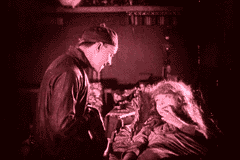
Griffith seems to genuinely admire the transformation of the lead from idealist
Buddhist, to resigned merchant, to Zen avenger, though the overly poetic
intertitles sometimes keep things from being readily apparent (and the way that
he creepily places Lucy on an altar once he gets her makes things even more
ambiguous). It’s to its credit that for all of the seriousness that’s
bandied about, Broken Blossoms rarely
feels like a preachy “issues” movie. The horrible tragedy that Griffith
serves up can be seen coming from the first reel, but it has an indelible and
undeniable power when it finally arrives.
Still, the
film’s frequent bouts of violence are tremendously effective when placed
against the general tenderness that permeates this ghetto. The raging face of
Battling Burrows, the piece’s villain, as it moves in to strike is absolutely
terrifying, and there’s always a threat of harm hanging behind the misty
landscape that Griffith paints. The fog that covers the streets of London seems
to cloud the minds of those who live there. The cast is comprised of uncouth
creatures but a Victorian sense of propriety weighs heavily upon them. They are
punished for indulging themselves, since their transgressions step outside the
realm of some arbitrary sense of decorum. Most of the citizens here are too high
on opium or too obsessed with bloodthirsty boxing matches to notice the inner beauty
of the heroine, and that might be the greatest tragedy that’s served up.
Griffith seems to genuinely admire the transformation of the lead from idealist
Buddhist, to resigned merchant, to Zen avenger, though the overly poetic
intertitles sometimes keep things from being readily apparent (and the way that
he creepily places Lucy on an altar once he gets her makes things even more
ambiguous). It’s to its credit that for all of the seriousness that’s
bandied about, Broken Blossoms rarely
feels like a preachy “issues” movie. The horrible tragedy that Griffith
serves up can be seen coming from the first reel, but it has an indelible and
undeniable power when it finally arrives.
* * * 1/2
02-04-02
Jeremy Heilman
|
