|
Newest Reviews:
New Movies -
The Tunnel
V/H/S
The Tall Man
Mama Africa
Detention
Brake
Ted
Tomboy
Brownian Movement
Last Ride
[Rec]³: Genesis
Hara-Kiri: Death of a Samurai
Indie Game: The Movie
Abraham Lincoln: Vampire Hunter
Old Movies -
Touki Bouki: The Journey of the Hyena
Drums Along the Mohawk
The Chase
The Heiress
Show
People
The Strange Affair of Uncle Harry
Pitfall
Driftwood
Miracle Mile
The Great Flamarion
Dark Habits
Archives -
Recap: 2000,
2001, 2002,
2003, 2004
, 2005, 2006,
2007 , 2008
, 2009 ,
2010 , 2011 ,
2012
All reviews alphabetically
All reviews by star rating
All reviews by release year
Masterpieces
Screening Log
Links
FAQ
E-mail me
HOME
| |
The Raven (Henri-Georges Clouzot, 1943)
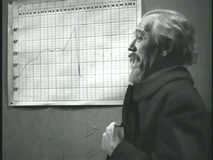 Henri-Georges Clouzot, generally
regarded as France’s master of suspense, delivers a transfixing tale of a
small town’s incestuous suspicions with The
Raven (Le Corbeau). In the film,
trouble starts brewing as a series of accusatory, almost omnipotent poison pen
letters surface, each mysteriously signed by “The Raven”. Before long, the
hysteria caused by the anonymous letters sparks a witch hunt. Copycat letters
spring up as malice begets more malice and quick social ostracism faces anyone
who appears to have been the least bit involved in their writing. Along the way,
the script offers up numerous red herrings, and even though it becomes
predictable before it reveals its final twists, Clouzot thankfully rejiggers the
movie along the way so that it’s not a whodunit so much as a “who’s gonna
get it?”. Because the script sometimes takes a facile approach to
characterization (e.g. the good girl / bad girl dichotomy is reversed all too
predictably), it doesn’t really pack that much power as an indictment of
humankind’s inherent fallibility, but it’s an entertaining, albeit cynical,
story nonetheless. Henri-Georges Clouzot, generally
regarded as France’s master of suspense, delivers a transfixing tale of a
small town’s incestuous suspicions with The
Raven (Le Corbeau). In the film,
trouble starts brewing as a series of accusatory, almost omnipotent poison pen
letters surface, each mysteriously signed by “The Raven”. Before long, the
hysteria caused by the anonymous letters sparks a witch hunt. Copycat letters
spring up as malice begets more malice and quick social ostracism faces anyone
who appears to have been the least bit involved in their writing. Along the way,
the script offers up numerous red herrings, and even though it becomes
predictable before it reveals its final twists, Clouzot thankfully rejiggers the
movie along the way so that it’s not a whodunit so much as a “who’s gonna
get it?”. Because the script sometimes takes a facile approach to
characterization (e.g. the good girl / bad girl dichotomy is reversed all too
predictably), it doesn’t really pack that much power as an indictment of
humankind’s inherent fallibility, but it’s an entertaining, albeit cynical,
story nonetheless.
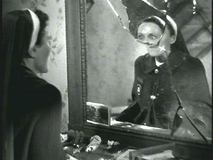 Photographed so that it appears to be
shadowy even during scenes that take place in broad daylight, The
Raven visually reflects the dark inner recesses that drive its characters to
spread their ill wills. With canted camera angles, broken mirrors and a
proto-noir style, the film not only preaches a pessimistic attitude that
nullifies simplistic morality by assuming we all posses some strain of evil, but
also makes that idea literal. Even if the movie is more efficient than superb,
one has to admit that it’s awfully efficient, with a minimal number of
subplots getting in the way of its single-minded attack on the town’s rapid
moral corrosion. It’s precisely because Clouzot has a clear didactic intent
here that his film isn’t more effective as a thriller. He aims for and
achieves an unambiguous message, but in doing so takes a small toll on the story
that he’s telling. If one does consider the film to be an allegory that
condemns France’s Nazi occupation, at least there’s some added perversity to
be found in the ways the movie demonstrates the corruptibility of those in
power. One doesn’t need to take such an approach to enjoy The
Raven, however. It’s so deftly made, superbly acted and relentlessly
bitter that it manages to condemn repression, hypocrisy and those eager to be
judgmental on a universal level. Photographed so that it appears to be
shadowy even during scenes that take place in broad daylight, The
Raven visually reflects the dark inner recesses that drive its characters to
spread their ill wills. With canted camera angles, broken mirrors and a
proto-noir style, the film not only preaches a pessimistic attitude that
nullifies simplistic morality by assuming we all posses some strain of evil, but
also makes that idea literal. Even if the movie is more efficient than superb,
one has to admit that it’s awfully efficient, with a minimal number of
subplots getting in the way of its single-minded attack on the town’s rapid
moral corrosion. It’s precisely because Clouzot has a clear didactic intent
here that his film isn’t more effective as a thriller. He aims for and
achieves an unambiguous message, but in doing so takes a small toll on the story
that he’s telling. If one does consider the film to be an allegory that
condemns France’s Nazi occupation, at least there’s some added perversity to
be found in the ways the movie demonstrates the corruptibility of those in
power. One doesn’t need to take such an approach to enjoy The
Raven, however. It’s so deftly made, superbly acted and relentlessly
bitter that it manages to condemn repression, hypocrisy and those eager to be
judgmental on a universal level.
67
03-10-04
Jeremy Heilman
|
