|
Newest Reviews:
New Movies -
The Tunnel
V/H/S
The Tall Man
Mama Africa
Detention
Brake
Ted
Tomboy
Brownian Movement
Last Ride
[Rec]³: Genesis
Hara-Kiri: Death of a Samurai
Indie Game: The Movie
Abraham Lincoln: Vampire Hunter
Old Movies -
Touki Bouki: The Journey of the Hyena
Drums Along the Mohawk
The Chase
The Heiress
Show
People
The Strange Affair of Uncle Harry
Pitfall
Driftwood
Miracle Mile
The Great Flamarion
Dark Habits
Archives -
Recap: 2000,
2001, 2002,
2003, 2004
, 2005, 2006,
2007 , 2008
, 2009 ,
2010 , 2011 ,
2012
All reviews alphabetically
All reviews by star rating
All reviews by release year
Masterpieces
Screening Log
Links
FAQ
E-mail me
HOME
| |
Gilda (Charles Vidor) 1946
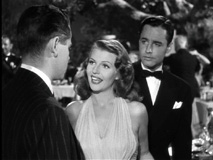 Gilda is the film noir that’s most notorious
because it cemented the sex symbol status of its star Rita Hayworth, which is
all the more impressive when looking at its sleazy environs. They seem more
conducive to grit than glamour, but there’s no denying Hayworth’s presence
in the titular role. Set in Argentina, this set-bound drama becomes in its
second half a modern Rapunzel story, with its longhaired star locked in a prison
of sexual frustration. It’s to the star’s credit that she never for a moment
lets the audience forget about her carnal desires. She’s oppressed by two men,
each spurned on by his jealousy of the other, but her predicament doesn’t
elicit audience sympathy so much as frustration that she might be in love with
one of them exclusively. Gilda is at her most sexual when she’s asking a
roomful of horny “gentlemen” to help her with zipper, even though the brain
tells you there’s a sick sort of pathos at work in the scene. With either of
the men, she seems too restrained to really glow. The constraints of marriage
cramp her style and that makes her dangerous. As an actress and a screen
presence, Hayworth has a lot of love, and sex appeal, to give. For her to
squander such riches on one suitor seems a tremendous waste.
Gilda is the film noir that’s most notorious
because it cemented the sex symbol status of its star Rita Hayworth, which is
all the more impressive when looking at its sleazy environs. They seem more
conducive to grit than glamour, but there’s no denying Hayworth’s presence
in the titular role. Set in Argentina, this set-bound drama becomes in its
second half a modern Rapunzel story, with its longhaired star locked in a prison
of sexual frustration. It’s to the star’s credit that she never for a moment
lets the audience forget about her carnal desires. She’s oppressed by two men,
each spurned on by his jealousy of the other, but her predicament doesn’t
elicit audience sympathy so much as frustration that she might be in love with
one of them exclusively. Gilda is at her most sexual when she’s asking a
roomful of horny “gentlemen” to help her with zipper, even though the brain
tells you there’s a sick sort of pathos at work in the scene. With either of
the men, she seems too restrained to really glow. The constraints of marriage
cramp her style and that makes her dangerous. As an actress and a screen
presence, Hayworth has a lot of love, and sex appeal, to give. For her to
squander such riches on one suitor seems a tremendous waste.
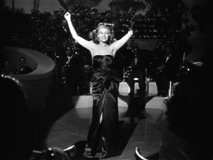 In most film noir, the underbelly of moral corruption is so
undeniable that it becomes visible in the visual elements of the film and the
behavior of the characters. Here, despite a subplot regarding a shady tungsten
monopoly, that corruption stems precisely from Gilda’s sexual potential. The
dressed up, but still obviously artificial sets that the action unfolds on only
reinforces the notion that Gilda’s sexual freedom is only illusory. She’s
punished in the movie because she threatens to burst the lid off of the sensual
repression. Charles Vidor’s workmanlike direction is smart, but not smart
enough to realize that it’s Gilda’s pathos that is the most interesting
here. He gives us the perspective of a slick but shallow protagonist (Glenn
Ford) instead of a more thorough examination of the biggest mystery in the movie
(though the Production Code might have made a look at Gilda’s motives
impossible). Ford provides voiceover narration, and even though it’s a staple
in the genre, it feels especially turgid and obligatory here. To complain that
Hayworth’s co-stars don’t exhibit as much energy as she does in Gilda seems
almost absurd though. Her presence here is so indomitable that it’s almost
surprising that Vidor found it necessary to bother putting other actors on the
screen at all.
In most film noir, the underbelly of moral corruption is so
undeniable that it becomes visible in the visual elements of the film and the
behavior of the characters. Here, despite a subplot regarding a shady tungsten
monopoly, that corruption stems precisely from Gilda’s sexual potential. The
dressed up, but still obviously artificial sets that the action unfolds on only
reinforces the notion that Gilda’s sexual freedom is only illusory. She’s
punished in the movie because she threatens to burst the lid off of the sensual
repression. Charles Vidor’s workmanlike direction is smart, but not smart
enough to realize that it’s Gilda’s pathos that is the most interesting
here. He gives us the perspective of a slick but shallow protagonist (Glenn
Ford) instead of a more thorough examination of the biggest mystery in the movie
(though the Production Code might have made a look at Gilda’s motives
impossible). Ford provides voiceover narration, and even though it’s a staple
in the genre, it feels especially turgid and obligatory here. To complain that
Hayworth’s co-stars don’t exhibit as much energy as she does in Gilda seems
almost absurd though. Her presence here is so indomitable that it’s almost
surprising that Vidor found it necessary to bother putting other actors on the
screen at all.
* * * 1/2
11-10-02
Jeremy Heilman
|
