
|
|
|
Newest Reviews: New Movies - Abraham Lincoln: Vampire Hunter Old Movies - Touki Bouki: The Journey of the Hyena The Strange Affair of Uncle Harry Archives - Recap: 2000, 2001, 2002, 2003, 2004 , 2005, 2006, 2007 , 2008 , 2009 , 2010 , 2011 , 2012
|
Germany Year Zero (Roberto Rossellini) 1947
“This movie, shot in Berlin in the summer of 1947, aims
only to be an objective and true portrait of this large, almost totally
destroyed city where 3.5 million people live a terrible desperate life, almost
without realizing it. They live as if tragedy were natural, not because of
strength or faith, but because they are tired. This is not an accusation or even
a defense of the German people. It is an objective assessment.” It’s not an entirely convincing argument for the film to make, since there’s a fair amount of dramatic artifice on display here, and it doesn’t really do good job of preparing the audience for what’s to come. Certainly, Rossellini isn’t being objective in this movie. There’s an obvious, albeit humanist, agenda at work in telling this story of a twelve year old German boy who does what he can to ease his family’s suffering in Germany’s postwar devastation. For example, the director includes a strong Christian moral that’s present mostly so audiences can despair when it becomes apparent that because of the boy’s harsh way of life, a wisp of faith is not enough to pull him back from the precipice of doom. He also has no problem using his style to pass judgment on most of his characters. Whatever he might write in the film’s opening passages, Rossellini is surely aware that using an overhead shot or a close-up in his movie has a certain inherent judgmental purpose, and he doesn’t restrain his style from including such cinematic language. Nothing demands that a film be even-handed, so this one’s insistence on its own objectivity is odd.
* * * * Jeremy Heilman 11-22-02 |
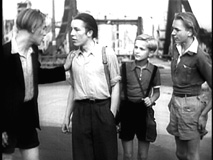 Roberto Rossellini’s grim neorealist work Germany
Year Zero opens with a boldly written preface that attempts to make clear
the reasons for the movie’s existence. Attempting to place the film as
something closer to a sociological artifact than a fictional drama, it rambles
on like this:
Roberto Rossellini’s grim neorealist work Germany
Year Zero opens with a boldly written preface that attempts to make clear
the reasons for the movie’s existence. Attempting to place the film as
something closer to a sociological artifact than a fictional drama, it rambles
on like this:
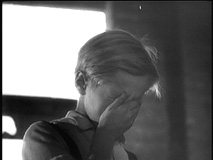 Even as Germany Year
Zero promotes a definite agenda, it remains admirable, because it
incorporates politics without sacrificing its technical and storytelling
virtues. Instead of sets, real locations are used, but the film feels a bit less
documentary-like than many other neorealist features. There’s a strong sense
of structure present in the plotting that makes the events that take place feel
more deterministic and less random than they should if a recreation of reality
was the movie’s key goal. Fortunately, this narrative cruelty comes off like a
series of unfortunate twists of fate, and as such it doesn’t detract from the
believability of the film, even as it makes it feel more like a written piece.
Fiction is hardly an art form to be embarrassed by, so Rossellini’s initial
posturing might have more to do with his reputation as a master of the
neorealist cinema at the time that he made Germany
Year Zero than his lack of awareness as to what he was doing in the film.
That his subsequent works all move away from strictly realistic constraints is
strongly suggestive that this movie acted as a bridge between the two styles.
Judged on its own, outside of the demands of the neorealist style, it works
quite well. The grave mood that dominates the film never allows the audience to
forget how miserable conditions were while the movie was being made. For
example, the boy’s father, is languishing on his death bed, mostly due to
malnutrition. A trip to an overcrowded hospital is looked at as a blessing, not
only because it staves off the threat of his death, but because it also because
when he’s not at home there’s one less mouth to feed. Doses of sobering
reality like that one filter in past any artifice inherent in the filmmaking
and infuse the briskly paced film with a sense of life that can’t be denied.
Even as Germany Year
Zero promotes a definite agenda, it remains admirable, because it
incorporates politics without sacrificing its technical and storytelling
virtues. Instead of sets, real locations are used, but the film feels a bit less
documentary-like than many other neorealist features. There’s a strong sense
of structure present in the plotting that makes the events that take place feel
more deterministic and less random than they should if a recreation of reality
was the movie’s key goal. Fortunately, this narrative cruelty comes off like a
series of unfortunate twists of fate, and as such it doesn’t detract from the
believability of the film, even as it makes it feel more like a written piece.
Fiction is hardly an art form to be embarrassed by, so Rossellini’s initial
posturing might have more to do with his reputation as a master of the
neorealist cinema at the time that he made Germany
Year Zero than his lack of awareness as to what he was doing in the film.
That his subsequent works all move away from strictly realistic constraints is
strongly suggestive that this movie acted as a bridge between the two styles.
Judged on its own, outside of the demands of the neorealist style, it works
quite well. The grave mood that dominates the film never allows the audience to
forget how miserable conditions were while the movie was being made. For
example, the boy’s father, is languishing on his death bed, mostly due to
malnutrition. A trip to an overcrowded hospital is looked at as a blessing, not
only because it staves off the threat of his death, but because it also because
when he’s not at home there’s one less mouth to feed. Doses of sobering
reality like that one filter in past any artifice inherent in the filmmaking
and infuse the briskly paced film with a sense of life that can’t be denied.