|
|
|
Newest Reviews: New Movies - Abraham Lincoln: Vampire Hunter Old Movies - Touki Bouki: The Journey of the Hyena The Strange Affair of Uncle Harry Archives - Recap: 2000, 2001, 2002, 2003, 2004 , 2005, 2006, 2007 , 2008 , 2009 , 2010 , 2011 , 2012
|
Orpheus (Jean Cocteau) 1949
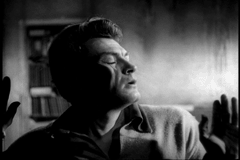
Cocteau rarely fumbles here, which is remarkable considering what he is attempting. The myth of Orpheus does not easily apply itself to modern times, but most of Cocteau's decisions in updating it seem dead on. Although he fumbles with some small details (the plastic gloves that Orpheus uses to enter another world seem tacky), most of the changes are truly inspired (Death's death-squad, riding on motorcycles with machine guns, are my favorite). He oddly chooses not to update the names of the characters even though he sets the film in France. Although this doesn't detract from the film to a remarkable degree, it distracts somewhat. The film is filled with the sort of simple yet convincing special effects that make Cocteau's films so magical. We can usually tell how a particular shot was accomplished, but at the same time that shot tends to impress due to the quality with which it was done. To even better effect, the film's emotional hook remains tangible. Orpheus' plights as an artist and as a lover receive equal billing here. Both are effective. The conclusion manages to make death (and Death) tragic. The film's only real flaw is that, as a solidly narrative feature, it has scenes of exposition that keep it from transporting us the way that some non-narrative films such as Un Chein Andalou or Cocteau's own Blood of a Poet can. **** October, 2001 Jeremy Heilman |
 The second, and most literal, in Jean Cocteau's "Orphic trilogy" his
1949 film Orpheus is a unique delight. The film has a completely original
sense of tone. It begins as a typically French celebration of beat-poet
aesthetics, but quickly morphs into a dreamlike travelogue into a fully realized
fantasy world. Along the way, the film constantly reinvents its mood. It becomes
a courtroom drama, melodramatic romance, a portrait of the suffering
artist, among other things, making for more unpredictable than a film based on
such a well-known myth has the right to be. For about ten inspired minutes near
the end it even turns into a screwball comedy, when Orpheus is told by the
judges of the underworld that he cannot ever look at his wife.
The second, and most literal, in Jean Cocteau's "Orphic trilogy" his
1949 film Orpheus is a unique delight. The film has a completely original
sense of tone. It begins as a typically French celebration of beat-poet
aesthetics, but quickly morphs into a dreamlike travelogue into a fully realized
fantasy world. Along the way, the film constantly reinvents its mood. It becomes
a courtroom drama, melodramatic romance, a portrait of the suffering
artist, among other things, making for more unpredictable than a film based on
such a well-known myth has the right to be. For about ten inspired minutes near
the end it even turns into a screwball comedy, when Orpheus is told by the
judges of the underworld that he cannot ever look at his wife.