|
Newest Reviews:
New Movies -
The Tunnel
V/H/S
The Tall Man
Mama Africa
Detention
Brake
Ted
Tomboy
Brownian Movement
Last Ride
[Rec]³: Genesis
Hara-Kiri: Death of a Samurai
Indie Game: The Movie
Abraham Lincoln: Vampire Hunter
Old Movies -
Touki Bouki: The Journey of the Hyena
Drums Along the Mohawk
The Chase
The Heiress
Show
People
The Strange Affair of Uncle Harry
Pitfall
Driftwood
Miracle Mile
The Great Flamarion
Dark Habits
Archives -
Recap: 2000,
2001, 2002,
2003, 2004
, 2005, 2006,
2007 , 2008
, 2009 ,
2010 , 2011 ,
2012
All reviews alphabetically
All reviews by star rating
All reviews by release year
Masterpieces
Screening Log
Links
FAQ
E-mail me
HOME
| |
Thieves' Highway (Jules Dassin, 1949)
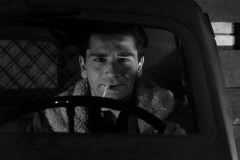 To the uninitiated the subject matter of
Jules Dassin’s Thieves’ Highway might seem a bit slight. After all,
it only focuses on the transport of a few truckloads of apples from the
grower’s grove to the greengrocer’s storefront. Despite that apparent
specificity, however, Dassin’s film emerges as a rather searing, wide-reaching
indictment of the necessary evils of doing business in the United States.
Featuring a group of immigrants tussling over the smallest of scores, it
demonstrates fundamental, ugly truths about America’s capitalist system. None
of the characters in the film are above scheming, backstabbing or strong-arming
another to get the money they feel they need here. Even though the script
eventually arranges the sins of its cast into a hierarchy of acceptable
behaviors, it doesn’t feel it necessary to endlessly moralize about them.
Instead, the film feels more awake to the realities of the world than the
average noir, because it doesn’t simply recoil from the flaws of people with
bitterness: it expects and forgives them. Thieves’ Highway, despite its
melodramatic trappings, is a film alive to the complexities of economics. When
its inevitable Code-mandated finale rolls, its revelations feel less like a
happy ending than the end of an idealist’s naiveté. To the uninitiated the subject matter of
Jules Dassin’s Thieves’ Highway might seem a bit slight. After all,
it only focuses on the transport of a few truckloads of apples from the
grower’s grove to the greengrocer’s storefront. Despite that apparent
specificity, however, Dassin’s film emerges as a rather searing, wide-reaching
indictment of the necessary evils of doing business in the United States.
Featuring a group of immigrants tussling over the smallest of scores, it
demonstrates fundamental, ugly truths about America’s capitalist system. None
of the characters in the film are above scheming, backstabbing or strong-arming
another to get the money they feel they need here. Even though the script
eventually arranges the sins of its cast into a hierarchy of acceptable
behaviors, it doesn’t feel it necessary to endlessly moralize about them.
Instead, the film feels more awake to the realities of the world than the
average noir, because it doesn’t simply recoil from the flaws of people with
bitterness: it expects and forgives them. Thieves’ Highway, despite its
melodramatic trappings, is a film alive to the complexities of economics. When
its inevitable Code-mandated finale rolls, its revelations feel less like a
happy ending than the end of an idealist’s naiveté.
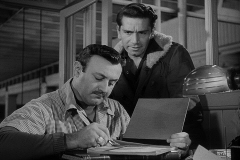 The dominance of immigrant characters in
Thieves’ Highway makes it feel like the work of an expatriate director
(ironically, Dassin would later leave American soil himself), rather than one
who was born in the United States. Though the hero, a war veteran (Richard
Conte), who comes home healthy only to find his father crippled by the enemy
within, is a second-generation American, he might be the only one in the cast
that qualifies as such. More typical of the films’ characters is Italian Rica
(Valentina Cortesa), a prostitute who seems equally likely to betray and deserve
trust. Her exotic, distinctly European character lends a strong erotic charge to
the film’s Southern California setting. An actor plays the most clearly
defined villain of the piece in a turn that’s just as memorable. Lee J. Cobb,
prefacing his most famous role as On the Waterfront’s corrupt union
leader, is Mike Figlia, who’s too sensible a businessman to seem truly evil.
Though Highway has the crisp shadows of Dassin’s other noir works and
as many exceptional action scenes of any of the director’s films, it’s the
characters that make the biggest impression this time. Far more potent than the
era’s other famed trucker picture, 1940’s They Drive By Night, Thieves’
Highway is one of Dassin’s very best. The dominance of immigrant characters in
Thieves’ Highway makes it feel like the work of an expatriate director
(ironically, Dassin would later leave American soil himself), rather than one
who was born in the United States. Though the hero, a war veteran (Richard
Conte), who comes home healthy only to find his father crippled by the enemy
within, is a second-generation American, he might be the only one in the cast
that qualifies as such. More typical of the films’ characters is Italian Rica
(Valentina Cortesa), a prostitute who seems equally likely to betray and deserve
trust. Her exotic, distinctly European character lends a strong erotic charge to
the film’s Southern California setting. An actor plays the most clearly
defined villain of the piece in a turn that’s just as memorable. Lee J. Cobb,
prefacing his most famous role as On the Waterfront’s corrupt union
leader, is Mike Figlia, who’s too sensible a businessman to seem truly evil.
Though Highway has the crisp shadows of Dassin’s other noir works and
as many exceptional action scenes of any of the director’s films, it’s the
characters that make the biggest impression this time. Far more potent than the
era’s other famed trucker picture, 1940’s They Drive By Night, Thieves’
Highway is one of Dassin’s very best.
79
Jeremy Heilman
02-11-04
|
