
|
|
|
Newest Reviews: New Movies - Abraham Lincoln: Vampire Hunter Old Movies - Touki Bouki: The Journey of the Hyena The Strange Affair of Uncle Harry Archives - Recap: 2000, 2001, 2002, 2003, 2004 , 2005, 2006, 2007 , 2008 , 2009 , 2010 , 2011 , 2012
|
M. Hulot's Holiday (Jacques Tati) 1953
The comedy on display here is unique in that it never stops to tell the audience it's being funny. There no musical cues or even pauses in the action to give notice that a laugh is expected. Most of the humor in the film is not very explicit. It focuses on the foibles of the people on vacation. They rush to get the newspaper or answer a business phone call, and approach their leisure activities as if they are additional work. There is an abundance of small talk, but almost none of the dialog matters much. Like a silent comedy, Tati's film works mainly on a visual level, and, luckily, the film's cinematography is quite good. It is not surprising that we are supposed to identify with the Hulot character, since the director himself plays him. In the film, Hulot is the only character that seems to be taking the vacation in at the pace one should. The film shares this unhurriedness.
***1/2 October 2001 Jeremy Heilman
|
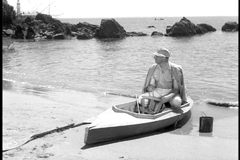 One of the few physical comedies to win widespread acclaim as an art film,
Jacques Tati's M. Hulot's Holiday is a film so unique that it is tough to
describe in typical cinematic terms. The film follows M. Hulot, a bumbling
vacationer played by Tati himself, as he goes to a seaside resort for a week's
vacation. The film feels more like a travelogue than a narrative. There are few
close-ups, as almost every shot is framed as if it were a vacation photo. The
film's final shot even adds a stamp to the picture postcard-like image. Needless
to say, there's a warm sense of nostalgia to the film. There's also an unforced
feel that makes it unlike nearly any other screen comedy (to even call it a
comedy is misleading, as the film is more exceptionally clever than overtly
funny).
One of the few physical comedies to win widespread acclaim as an art film,
Jacques Tati's M. Hulot's Holiday is a film so unique that it is tough to
describe in typical cinematic terms. The film follows M. Hulot, a bumbling
vacationer played by Tati himself, as he goes to a seaside resort for a week's
vacation. The film feels more like a travelogue than a narrative. There are few
close-ups, as almost every shot is framed as if it were a vacation photo. The
film's final shot even adds a stamp to the picture postcard-like image. Needless
to say, there's a warm sense of nostalgia to the film. There's also an unforced
feel that makes it unlike nearly any other screen comedy (to even call it a
comedy is misleading, as the film is more exceptionally clever than overtly
funny). 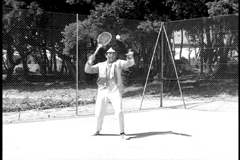 One final thing to note would be the sheer physical grace of the film. Hulot's
movements are exact, yet feel unpredictable. They provide a great deal of the
film's humor. This, like everything else in the film, is so far from insistent
that it almost feels accidental. It is only in retrospect that we can reflect on
the film, and see that nearly nothing in this charming puff of a film was. Tati
followed this film with several sequels, but none kept quite the same optimistic
outlook on the world as this one.
One final thing to note would be the sheer physical grace of the film. Hulot's
movements are exact, yet feel unpredictable. They provide a great deal of the
film's humor. This, like everything else in the film, is so far from insistent
that it almost feels accidental. It is only in retrospect that we can reflect on
the film, and see that nearly nothing in this charming puff of a film was. Tati
followed this film with several sequels, but none kept quite the same optimistic
outlook on the world as this one.