|
Newest Reviews:
New Movies -
The Tunnel
V/H/S
The Tall Man
Mama Africa
Detention
Brake
Ted
Tomboy
Brownian Movement
Last Ride
[Rec]³: Genesis
Hara-Kiri: Death of a Samurai
Indie Game: The Movie
Abraham Lincoln: Vampire Hunter
Old Movies -
Touki Bouki: The Journey of the Hyena
Drums Along the Mohawk
The Chase
The Heiress
Show
People
The Strange Affair of Uncle Harry
Pitfall
Driftwood
Miracle Mile
The Great Flamarion
Dark Habits
Archives -
Recap: 2000,
2001, 2002,
2003, 2004
, 2005, 2006,
2007 , 2008
, 2009 ,
2010 , 2011 ,
2012
All reviews alphabetically
All reviews by star rating
All reviews by release year
Masterpieces
Screening Log
Links
FAQ
E-mail me
HOME
| |
The Trouble With Harry (Alfred Hitchcock, 1955)
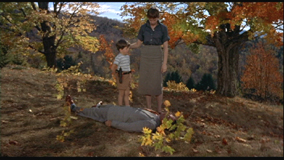 The gorgeous New England backdrops that
colorize Alfred Hitchcock’s droll black comedy The
Trouble With Harry are clearly an idealized abstraction of reality, but the
movie mines tension from the presence of that idealism. When fate dumps death
into the autumnal small town atmosphere that Hitchcock so fastidiously creates,
it threatens to upset the balance of his tightly controlled environment. The
people that gather around the titular corpse attempt to maintain decorum as they
attempt to rid themselves of it. Against all reason, they each remain at ease
with its presence, and from that acceptance of death, they begin to live. The
comedic engine is always in plain view here, partly because the exaggeratedly
picaresque setting is so intrinsic to the gag and partly because there’s
inherent contrivance in the on-again, off-again roundelay that the characters go
through as they repeatedly bury and exhume Harry’s corpse. Despite the
artifice, or perhaps partly because of it, the film manages to be enjoyable. The gorgeous New England backdrops that
colorize Alfred Hitchcock’s droll black comedy The
Trouble With Harry are clearly an idealized abstraction of reality, but the
movie mines tension from the presence of that idealism. When fate dumps death
into the autumnal small town atmosphere that Hitchcock so fastidiously creates,
it threatens to upset the balance of his tightly controlled environment. The
people that gather around the titular corpse attempt to maintain decorum as they
attempt to rid themselves of it. Against all reason, they each remain at ease
with its presence, and from that acceptance of death, they begin to live. The
comedic engine is always in plain view here, partly because the exaggeratedly
picaresque setting is so intrinsic to the gag and partly because there’s
inherent contrivance in the on-again, off-again roundelay that the characters go
through as they repeatedly bury and exhume Harry’s corpse. Despite the
artifice, or perhaps partly because of it, the film manages to be enjoyable.
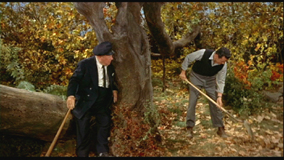 Throughout the course of one very
exhausting day, the townsfolk go about exchanging pleasantries and starting up
new romances while staring death in the face. Even when Harry’s body isn’t
on screen, there are reminders of danger, such as the dead rabbit a boy totes
about as a plaything or the vague threat of justice embodied by the bumbling
Deputy Sheriff. The ghoulish subject matter always bubbles just under the
superficially quaint surface of the characters’ actions, but their resolve
denies it any more presence than that. Almost subconsciously, the characters
seem to be deploying their good cheer and nonchalance as a coping mechanism and
it empowers them to face their mortality head on. Perhaps most interesting
though is the way that their insistent defiance of death threatens to carry over
to their discussions of sex. At first, any candor that they have when dealing
with death dissolves when sexual issues are raised. One character’s
description of “horrible masculine sounds” made during an attempted rape is
funny because of the disparity between the frankness that’s come before and
the timidity on display, but that frigidity slowly erodes as they grow more
comfortable with their situation. As in most of Hitchcock’s other work sexual
repression, can’t exist without being intertwined with the menace of death,
and for every surprise related to Harry’s fate, there seems to be one relating
to the amorous intentions of the characters. What’s most telling about
Hitchcock’s intentions here is that it’s the romantic revelations that have
the most emotional weight. Despite the presence of madness, rape, and murder,
the film isn’t suspenseful in conventional terms until its final minutes, and
that’s because the character that The Trouble With Harry is least
concerned with is Harry himself. Throughout the course of one very
exhausting day, the townsfolk go about exchanging pleasantries and starting up
new romances while staring death in the face. Even when Harry’s body isn’t
on screen, there are reminders of danger, such as the dead rabbit a boy totes
about as a plaything or the vague threat of justice embodied by the bumbling
Deputy Sheriff. The ghoulish subject matter always bubbles just under the
superficially quaint surface of the characters’ actions, but their resolve
denies it any more presence than that. Almost subconsciously, the characters
seem to be deploying their good cheer and nonchalance as a coping mechanism and
it empowers them to face their mortality head on. Perhaps most interesting
though is the way that their insistent defiance of death threatens to carry over
to their discussions of sex. At first, any candor that they have when dealing
with death dissolves when sexual issues are raised. One character’s
description of “horrible masculine sounds” made during an attempted rape is
funny because of the disparity between the frankness that’s come before and
the timidity on display, but that frigidity slowly erodes as they grow more
comfortable with their situation. As in most of Hitchcock’s other work sexual
repression, can’t exist without being intertwined with the menace of death,
and for every surprise related to Harry’s fate, there seems to be one relating
to the amorous intentions of the characters. What’s most telling about
Hitchcock’s intentions here is that it’s the romantic revelations that have
the most emotional weight. Despite the presence of madness, rape, and murder,
the film isn’t suspenseful in conventional terms until its final minutes, and
that’s because the character that The Trouble With Harry is least
concerned with is Harry himself.
* * *
05-30-03
Jeremy Heilman
|
