|
Newest Reviews:
New Movies -
The Tunnel
V/H/S
The Tall Man
Mama Africa
Detention
Brake
Ted
Tomboy
Brownian Movement
Last Ride
[Rec]³: Genesis
Hara-Kiri: Death of a Samurai
Indie Game: The Movie
Abraham Lincoln: Vampire Hunter
Old Movies -
Touki Bouki: The Journey of the Hyena
Drums Along the Mohawk
The Chase
The Heiress
Show
People
The Strange Affair of Uncle Harry
Pitfall
Driftwood
Miracle Mile
The Great Flamarion
Dark Habits
Archives -
Recap: 2000,
2001, 2002,
2003, 2004
, 2005, 2006,
2007 , 2008
, 2009 ,
2010 , 2011 ,
2012
All reviews alphabetically
All reviews by star rating
All reviews by release year
Masterpieces
Screening Log
Links
FAQ
E-mail me
HOME
| |
The Fall of the House of Usher (Roger Corman) 1960
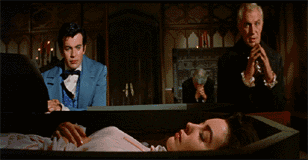 The first of Roger Corman’s many adaptations of Edgar Allen Poe stories,
The Fall of the House of Usher is a classy, stately chiller. Modern horror films
might offer a more visceral kick than Corman’s glorified (horrified?) costume
dramas, but they rarely offer the surprisingly tasteful restraint or the solid
acting that was typical of them. Although Corman seems to revel in his “King
of the B’s” moniker, it seems somewhat less than accurate. Clearly this
film, which had a budget of $200,000 (modest by even 1960’s standards), wrings
a great deal of value out of that investment. Corman’s work in this period
wasn’t cheap. It was frugal. His eye for talent and his willingness to later
become a leading distributor of foreign films (e.g. Cries and Whispers and
Amarcord) show that he was less the hack that he claimed to be than an artist.
The first of Roger Corman’s many adaptations of Edgar Allen Poe stories,
The Fall of the House of Usher is a classy, stately chiller. Modern horror films
might offer a more visceral kick than Corman’s glorified (horrified?) costume
dramas, but they rarely offer the surprisingly tasteful restraint or the solid
acting that was typical of them. Although Corman seems to revel in his “King
of the B’s” moniker, it seems somewhat less than accurate. Clearly this
film, which had a budget of $200,000 (modest by even 1960’s standards), wrings
a great deal of value out of that investment. Corman’s work in this period
wasn’t cheap. It was frugal. His eye for talent and his willingness to later
become a leading distributor of foreign films (e.g. Cries and Whispers and
Amarcord) show that he was less the hack that he claimed to be than an artist.
That eye for talent is clearly on display in The Fall of the
House of Usher. The film’s script was the second written by novelist Richard
Matheson. It shouldn’t be surprising, then, to find the work is relatively
faithful in tone to Poe’s short story. The feeling of disgust that permeates
the narrator’s view of the house is present here. The film shifts his
motivation for being in the home a bit, perhaps to help add to the running time
(which is already a brief eighty minutes), but it doesn’t do much to ruin the
film’s effect. In fact, the love triangle that is set up manages to draw out
the original story’s incestuous implications. There is very little to complain
about considering the source material for the film was only a few scant pages
long. The additions seem rather organically integrated into the film’s world.
 Whatever gripes the liberties that are taken by the plot might cause are more
than made up for by the film’s other aspects. The look of the film is
unsettling. Despite its Technicolor stock, the film manages to convey a serious
sense of gloom. The presence of Vincent Price, quite effective as the sinister
Roderick Usher, only adds to the pervasive bad mood that envelopes the film. It
is somewhat unfortunate that there are few moments in the running time that
manage to actually scare (as opposed to disturb), and I am not quite sure how
the film would play to the majority of modern audiences. Still, I found it to be
a thoroughly engaging entry in the literary horror landscape.
Whatever gripes the liberties that are taken by the plot might cause are more
than made up for by the film’s other aspects. The look of the film is
unsettling. Despite its Technicolor stock, the film manages to convey a serious
sense of gloom. The presence of Vincent Price, quite effective as the sinister
Roderick Usher, only adds to the pervasive bad mood that envelopes the film. It
is somewhat unfortunate that there are few moments in the running time that
manage to actually scare (as opposed to disturb), and I am not quite sure how
the film would play to the majority of modern audiences. Still, I found it to be
a thoroughly engaging entry in the literary horror landscape.
***
11-07-01
Jeremy Heilman
|
