|
Newest Reviews:
New Movies -
The Tunnel
V/H/S
The Tall Man
Mama Africa
Detention
Brake
Ted
Tomboy
Brownian Movement
Last Ride
[Rec]³: Genesis
Hara-Kiri: Death of a Samurai
Indie Game: The Movie
Abraham Lincoln: Vampire Hunter
Old Movies -
Touki Bouki: The Journey of the Hyena
Drums Along the Mohawk
The Chase
The Heiress
Show
People
The Strange Affair of Uncle Harry
Pitfall
Driftwood
Miracle Mile
The Great Flamarion
Dark Habits
Archives -
Recap: 2000,
2001, 2002,
2003, 2004
, 2005, 2006,
2007 , 2008
, 2009 ,
2010 , 2011 ,
2012
All reviews alphabetically
All reviews by star rating
All reviews by release year
Masterpieces
Screening Log
Links
FAQ
E-mail me
HOME
| |
Darling (John Schlesinger, 1965)
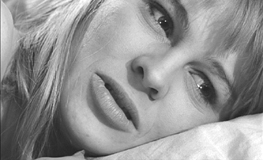 Combining the high-gloss presentation of
a Hollywood women’s picture with social commentary that might be mistaken for
pointed were it not so blunt, John Schlesinger’s Darling
suffers the same fate as its protagonist Diana (Julie Christie). In a somewhat
admirable, but ultimately misguided attempt to have it all, it gives up its very
soul. For the first act, the Schlesinger presents Diana’s bad behavior
unabashedly (if sometimes obscurely – her emotional shifts start, and remain,
at an arm’s length). The film suggests she’s a product of her society, warts
and all, and in its opening scenes, does so with a bit of style and subtlety.
Her transgressions seem minor at first, and her bad judgments are demonstrably
the price paid for freedom of choice. Around the movie’s midpoint, things go a
bit haywire, as the movie seems to doubt its own effectiveness as satire, and
begins overplaying. An upper-class party abroad explicitly and lamely recalls
Fellini as Diana flirts with la dolce vita. Later, as she becomes the bored
trophy wife of an Italian prince, Schlesinger seems to be channeling Antonioni,
and badly. The movie is infused with the wildly experimental, extremely dated
style of so many once-classic films of the Sixties. Every other scene features
some sort of reminder that the audience is, indeed, watching a film, whether
it’s a freeze frame, a jump cut, a stab at documentary realism, or a
character’s direct assault on the camera. It’s not consistent, and leaves
the feeling that individual scenes work better than the whole, ungainly beast. Combining the high-gloss presentation of
a Hollywood women’s picture with social commentary that might be mistaken for
pointed were it not so blunt, John Schlesinger’s Darling
suffers the same fate as its protagonist Diana (Julie Christie). In a somewhat
admirable, but ultimately misguided attempt to have it all, it gives up its very
soul. For the first act, the Schlesinger presents Diana’s bad behavior
unabashedly (if sometimes obscurely – her emotional shifts start, and remain,
at an arm’s length). The film suggests she’s a product of her society, warts
and all, and in its opening scenes, does so with a bit of style and subtlety.
Her transgressions seem minor at first, and her bad judgments are demonstrably
the price paid for freedom of choice. Around the movie’s midpoint, things go a
bit haywire, as the movie seems to doubt its own effectiveness as satire, and
begins overplaying. An upper-class party abroad explicitly and lamely recalls
Fellini as Diana flirts with la dolce vita. Later, as she becomes the bored
trophy wife of an Italian prince, Schlesinger seems to be channeling Antonioni,
and badly. The movie is infused with the wildly experimental, extremely dated
style of so many once-classic films of the Sixties. Every other scene features
some sort of reminder that the audience is, indeed, watching a film, whether
it’s a freeze frame, a jump cut, a stab at documentary realism, or a
character’s direct assault on the camera. It’s not consistent, and leaves
the feeling that individual scenes work better than the whole, ungainly beast.
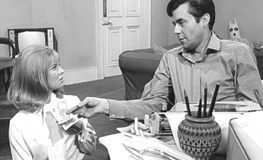 This cheaply ironic tale is narrated by
Diana, supposedly in the guise of an interview being conducted for a fashionable
woman’s magazine. Oddly, the film, as directed, features a level of distance
from her life that she clearly doesn’t possess, which leaves that device
feeling rather pointless. Melodrama doesn’t require a director to jump through
such hoops, and generally intensifies with closeness to its characters. One only
needs to look at the masters of the genre to find Darling
lacking. For example, Douglas Sirk managed to make subversive, pointed
critiques about our lives while still provoking tears. Perhaps, that’s because
he at least had enough optimism to acknowledge that there was room for hope in
his characters’ lives before he had social forces steamroll it. Because of the
obviousness of Darling’s approach,
there’s opportunity for little but vehement condemnation. As a result of
Schlesinger’s misfiring ambitions, the enjoyment in this familiar story is
nearly suffocated. As social commentary, it falls back on too many of the
lame-brained attacks (e.g. aristocrats are surrounded by sex, yet impotent) that
populated the pictures of the era to be effective or relevant. As
sporadically decent as Darling is as a
soap opera, and as accomplished, if unlikable, as the performances are,
there’s no escaping that it’s a movie that achieves little of the
intellectual importance that it shoots for. This cheaply ironic tale is narrated by
Diana, supposedly in the guise of an interview being conducted for a fashionable
woman’s magazine. Oddly, the film, as directed, features a level of distance
from her life that she clearly doesn’t possess, which leaves that device
feeling rather pointless. Melodrama doesn’t require a director to jump through
such hoops, and generally intensifies with closeness to its characters. One only
needs to look at the masters of the genre to find Darling
lacking. For example, Douglas Sirk managed to make subversive, pointed
critiques about our lives while still provoking tears. Perhaps, that’s because
he at least had enough optimism to acknowledge that there was room for hope in
his characters’ lives before he had social forces steamroll it. Because of the
obviousness of Darling’s approach,
there’s opportunity for little but vehement condemnation. As a result of
Schlesinger’s misfiring ambitions, the enjoyment in this familiar story is
nearly suffocated. As social commentary, it falls back on too many of the
lame-brained attacks (e.g. aristocrats are surrounded by sex, yet impotent) that
populated the pictures of the era to be effective or relevant. As
sporadically decent as Darling is as a
soap opera, and as accomplished, if unlikable, as the performances are,
there’s no escaping that it’s a movie that achieves little of the
intellectual importance that it shoots for.
56
02-12-04
Jeremy Heilman
|
