The Saragossa Manuscript (Wojciech Has) 1965
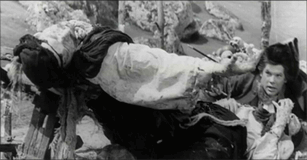 Set in Spain during the Napoleonic Wars, Wojciech Has’ The
Saragossa Manuscript is surely one of the most convolutedly plotted films
ever to reach the silver screen. At an epic three hours and two minutes long,
the film has plenty of time to spin its story, and the story, actually I should
say stories, that get spun are so intertwined and desultory that you keep
waiting for the movie to run out of narrative thread, but it never does. This
yarn keeps on unraveling, leaving the audience, like its main character in a
protean state where they don’t know what’s real and what’s fiction. It’s
nearly impossible not to get overwhelmed at times by the scope of the film. The
novel that the film is based on has reportedly made the transfer with an unusual
amount of fidelity, and it shows. The intricate structure turns its stories of
swashbuckling, religious guilt, mischievous demons, and harem girls into an
examination, and satire, or narrative itself.
Set in Spain during the Napoleonic Wars, Wojciech Has’ The
Saragossa Manuscript is surely one of the most convolutedly plotted films
ever to reach the silver screen. At an epic three hours and two minutes long,
the film has plenty of time to spin its story, and the story, actually I should
say stories, that get spun are so intertwined and desultory that you keep
waiting for the movie to run out of narrative thread, but it never does. This
yarn keeps on unraveling, leaving the audience, like its main character in a
protean state where they don’t know what’s real and what’s fiction. It’s
nearly impossible not to get overwhelmed at times by the scope of the film. The
novel that the film is based on has reportedly made the transfer with an unusual
amount of fidelity, and it shows. The intricate structure turns its stories of
swashbuckling, religious guilt, mischievous demons, and harem girls into an
examination, and satire, or narrative itself.
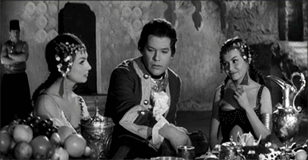 As the film proceeds, the hero, who is a character himself
in a book that two soldiers in the opening scenes stop fighting to read,
encounters person after person that wants to tell him a story. Many of the tales
have further narrators within them, creating a nesting narrative that at its
most complicated point goes seven levels deep. Random, subsidiary characters
tell some stories, while the hero himself tells others. Through dream sequences,
flashbacks, spoken narratives, and déjà vu (signified by recurring images),
the movie examines its mythical Spanish countryside through what feels like an
unlimited number of storyteller’s filters.
As the film proceeds, the hero, who is a character himself
in a book that two soldiers in the opening scenes stop fighting to read,
encounters person after person that wants to tell him a story. Many of the tales
have further narrators within them, creating a nesting narrative that at its
most complicated point goes seven levels deep. Random, subsidiary characters
tell some stories, while the hero himself tells others. Through dream sequences,
flashbacks, spoken narratives, and déjà vu (signified by recurring images),
the movie examines its mythical Spanish countryside through what feels like an
unlimited number of storyteller’s filters.
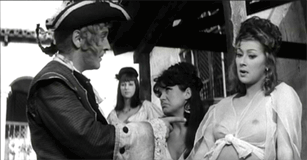 Despite the varying tones and narrators that populate The
Saragossa Manuscript, it’s tough to deny that the entire film feels as if
it’s being governed by a unified directorial style. Has’ film is filled with
technically superb shots that track slowly, and a cohesive look that might not be right for this
material. To celebrate the variety of voices that storytellers can take, and
then shoehorn them visually is a detriment to them. Also omnipresent is the
film’s sardonic tone, which never lets us forget that we shouldn’t be taking
anything that we see too seriously. Though the film is frequently funny, and the
humor is generally welcome, it also disarms the horror in film's frequent forays
into the supernatural. The surprising end doesn’t feel
that shocking, precisely because so much of the film was obviously constructed
to be taken with a grain of salt. Despite this, the impressive achievements of The
Saragossa Manuscript make it a singular, distinctive achievement. Few films
have anywhere near this much ambition, and as such small complaints are easy to
swallow.
Despite the varying tones and narrators that populate The
Saragossa Manuscript, it’s tough to deny that the entire film feels as if
it’s being governed by a unified directorial style. Has’ film is filled with
technically superb shots that track slowly, and a cohesive look that might not be right for this
material. To celebrate the variety of voices that storytellers can take, and
then shoehorn them visually is a detriment to them. Also omnipresent is the
film’s sardonic tone, which never lets us forget that we shouldn’t be taking
anything that we see too seriously. Though the film is frequently funny, and the
humor is generally welcome, it also disarms the horror in film's frequent forays
into the supernatural. The surprising end doesn’t feel
that shocking, precisely because so much of the film was obviously constructed
to be taken with a grain of salt. Despite this, the impressive achievements of The
Saragossa Manuscript make it a singular, distinctive achievement. Few films
have anywhere near this much ambition, and as such small complaints are easy to
swallow.
* * * 1/2
05-27-02
Jeremy Heilman
