|
Newest Reviews:
New Movies -
The Tunnel
V/H/S
The Tall Man
Mama Africa
Detention
Brake
Ted
Tomboy
Brownian Movement
Last Ride
[Rec]³: Genesis
Hara-Kiri: Death of a Samurai
Indie Game: The Movie
Abraham Lincoln: Vampire Hunter
Old Movies -
Touki Bouki: The Journey of the Hyena
Drums Along the Mohawk
The Chase
The Heiress
Show
People
The Strange Affair of Uncle Harry
Pitfall
Driftwood
Miracle Mile
The Great Flamarion
Dark Habits
Archives -
Recap: 2000,
2001, 2002,
2003, 2004
, 2005, 2006,
2007 , 2008
, 2009 ,
2010 , 2011 ,
2012
All reviews alphabetically
All reviews by star rating
All reviews by release year
Masterpieces
Screening Log
Links
FAQ
E-mail me
HOME
| |
Fiddler on the Roof (Norman Jewison, 1971)
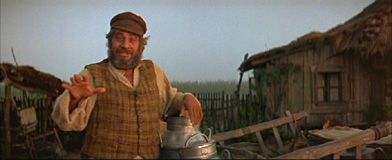 Norman Jewison’s mind-numbingly literal adaptation of the
stage musical Fiddler on the Roof is no disaster, but it certainly has
its limitations. At three hours long, the movie feels grotesquely bloated
whenever one has a moment of calm to consider its dearth of ideas. What remains
after the songs are stripped away is an odd sort of commercial for an idealized
life that supposedly once was. Because Tevye talks directly to God instead of
poring over books like his misguided Rabbi does, the film doesn’t sell Judaism
as a faith, but rather as a sort of Zen-philosophy that enables its believers to
write off any of life’s confrontations with a shrug and a smile. Even as sheer
entertainment, Fiddler fails to excite. It’s a musical with no truly
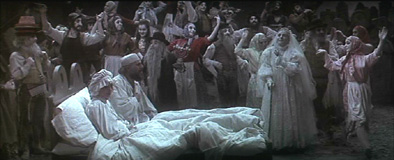
memorable musical numbers. The closest it gets is the mildly surreal sequence in
which Tevye recounts a made up dream filled with the ghosts of dead relatives to
his wife, and that suggests Jewison’s approach is entirely wrong for this
wistful material. There’s an ill fit between the squalid realism that is
present in the sets and the behavior of the characters, which is coy and clichéd
in the way of most musical comedies. It’s precisely the movie’s desire to
remain somewhat close to the traditions of the Jewish people in the song and
dance routines keeps the film from ever achieving any sort of delightful
spectacle.
Norman Jewison’s mind-numbingly literal adaptation of the
stage musical Fiddler on the Roof is no disaster, but it certainly has
its limitations. At three hours long, the movie feels grotesquely bloated
whenever one has a moment of calm to consider its dearth of ideas. What remains
after the songs are stripped away is an odd sort of commercial for an idealized
life that supposedly once was. Because Tevye talks directly to God instead of
poring over books like his misguided Rabbi does, the film doesn’t sell Judaism
as a faith, but rather as a sort of Zen-philosophy that enables its believers to
write off any of life’s confrontations with a shrug and a smile. Even as sheer
entertainment, Fiddler fails to excite. It’s a musical with no truly
memorable musical numbers. The closest it gets is the mildly surreal sequence in
which Tevye recounts a made up dream filled with the ghosts of dead relatives to
his wife, and that suggests Jewison’s approach is entirely wrong for this
wistful material. There’s an ill fit between the squalid realism that is
present in the sets and the behavior of the characters, which is coy and clichéd
in the way of most musical comedies. It’s precisely the movie’s desire to
remain somewhat close to the traditions of the Jewish people in the song and
dance routines keeps the film from ever achieving any sort of delightful
spectacle.
 As anti-spectacle, Fiddler is more successful,
except when the script asks for detachment from reality, which is practically
every time it presents a melodramatic entanglement for one of Tevye’s five
daughters. The cast is satisfyingly dowdy looking, and the sets, as mentioned
above, attempt to ground the film. Jewison’s editing choices demonstrate a
distinct lack of imagination, slipping into a rapid montage whenever the lyrics
allow for their contents to be presented verbatim. With the small exceptions of
a brief pogrom or two, the epic length of the film only presents more and more
numbing sameness as it trudges along like Tevye carrying his wagon on his back.
The greatest deficit in this version of Fiddler is the movie’s
inability to make the audience feel that the tradition its characters sing the
praises of is tragically fought for and lost. It almost seems to be surrendered
willingly, and as such there is little dramatic tension here. Combine that
complacency with the general lack of showiness and the film becomes a bit too
humble for its own good. Though Fiddler on the Roof rarely fully botches
the delivery of its maladroit tone, that alone can hardly be considered a great
achievement.
As anti-spectacle, Fiddler is more successful,
except when the script asks for detachment from reality, which is practically
every time it presents a melodramatic entanglement for one of Tevye’s five
daughters. The cast is satisfyingly dowdy looking, and the sets, as mentioned
above, attempt to ground the film. Jewison’s editing choices demonstrate a
distinct lack of imagination, slipping into a rapid montage whenever the lyrics
allow for their contents to be presented verbatim. With the small exceptions of
a brief pogrom or two, the epic length of the film only presents more and more
numbing sameness as it trudges along like Tevye carrying his wagon on his back.
The greatest deficit in this version of Fiddler is the movie’s
inability to make the audience feel that the tradition its characters sing the
praises of is tragically fought for and lost. It almost seems to be surrendered
willingly, and as such there is little dramatic tension here. Combine that
complacency with the general lack of showiness and the film becomes a bit too
humble for its own good. Though Fiddler on the Roof rarely fully botches
the delivery of its maladroit tone, that alone can hardly be considered a great
achievement.
* * 1/2
02-24-03
Jeremy Heilman
|
