|
Newest Reviews:
New Movies -
The Tunnel
V/H/S
The Tall Man
Mama Africa
Detention
Brake
Ted
Tomboy
Brownian Movement
Last Ride
[Rec]³: Genesis
Hara-Kiri: Death of a Samurai
Indie Game: The Movie
Abraham Lincoln: Vampire Hunter
Old Movies -
Touki Bouki: The Journey of the Hyena
Drums Along the Mohawk
The Chase
The Heiress
Show
People
The Strange Affair of Uncle Harry
Pitfall
Driftwood
Miracle Mile
The Great Flamarion
Dark Habits
Archives -
Recap: 2000,
2001, 2002,
2003, 2004
, 2005, 2006,
2007 , 2008
, 2009 ,
2010 , 2011 ,
2012
All reviews alphabetically
All reviews by star rating
All reviews by release year
Masterpieces
Screening Log
Links
FAQ
E-mail me
HOME
| |
The Homecoming (Peter Hall) 1973
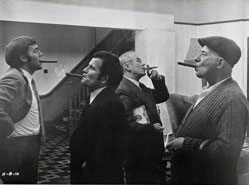 Based on a play by Harold Pinter, Peter Hall’s masterful
staging of The Homecoming is a family
dramedy that courts absurdity to powerfully make its point. Since the film was
made for producer Ely Landau’s ambitious American Film Theater project, the
movie isn’t terribly cinematic (though the proliferation of sharp close-ups
help us get closer to the actors), and the action takes place entirely on one
simple set. Still, it manages to spin a fascinating tale of familial
relationships that sticks with the viewer. It focuses on the fear that exists
especially among those who’ve had a bad childhood that bringing home a loved
one to meet the family might somehow reveal something repressed and result in a
transformation of that love. At the play’s start, Teddy (Michael Jayston), a
successful professor of philosophy, and his wife Ruth (Vivien Merchant) return
to Teddy’s London home for the first time in nine years. The rest of Teddy’s
uncomfortably close-knit family, including his two brothers, the lecherous pimp
Lenny and the vacuous boxer-in-training Joey (Ian Holm and Terence Rigby), his
senile, belligerent, and bitter father Max (Paul Rogers), and his fey uncle Sam
(Cyril Cusack), none of who have previously met Ruth, await them. The
testosterone runs rampant in this household without a woman, and once Ruth
arrives, her infusion of estrogen shifts the family’s dynamics immediately for
the worse.
Based on a play by Harold Pinter, Peter Hall’s masterful
staging of The Homecoming is a family
dramedy that courts absurdity to powerfully make its point. Since the film was
made for producer Ely Landau’s ambitious American Film Theater project, the
movie isn’t terribly cinematic (though the proliferation of sharp close-ups
help us get closer to the actors), and the action takes place entirely on one
simple set. Still, it manages to spin a fascinating tale of familial
relationships that sticks with the viewer. It focuses on the fear that exists
especially among those who’ve had a bad childhood that bringing home a loved
one to meet the family might somehow reveal something repressed and result in a
transformation of that love. At the play’s start, Teddy (Michael Jayston), a
successful professor of philosophy, and his wife Ruth (Vivien Merchant) return
to Teddy’s London home for the first time in nine years. The rest of Teddy’s
uncomfortably close-knit family, including his two brothers, the lecherous pimp
Lenny and the vacuous boxer-in-training Joey (Ian Holm and Terence Rigby), his
senile, belligerent, and bitter father Max (Paul Rogers), and his fey uncle Sam
(Cyril Cusack), none of who have previously met Ruth, await them. The
testosterone runs rampant in this household without a woman, and once Ruth
arrives, her infusion of estrogen shifts the family’s dynamics immediately for
the worse.
 The family reunion becomes a macabre display, as Pinter
puts dialogue in his cast’s mouths that suggests all ids have been checked at
the door. The words spoken alternate between the superficial politeness that
usually dominates this kind of reunion and the semi-psychotic, unspoken hang-ups
that are stirring underneath. Everyone plays his or her character with a
heightened, over-the-top performance, so that it soon becomes difficult to
regain any sense of reality. If the play suffers at all in its adaptation to the
screen it’s in its failure to visually let the audience know that it’s about
to launch into a surreal caricature of domestic life. Even after the movie fades
to black, when the image returns, the action is still set in the same sparely
decorated room. The dialogue clearly makes its dreamlike intentions known
though, and between its exaggerated macho posturing and the spasmodic body
language of the actors, the film begins to resemble some kind of obscene
slapstick comedy. As the film barrels toward its end, it manages to say
something poignant and disturbing about the decorum that dominates the
discussion in even the happiest of families, as well as snidely commenting on
the way that people tend to attempt to distort the past so that it might better
suit their needs. The Homecoming might be simple in its staging, but in a
final tally, it overcomes its lack of cinematic device through its
perceptiveness and stellar ensemble acting.
The family reunion becomes a macabre display, as Pinter
puts dialogue in his cast’s mouths that suggests all ids have been checked at
the door. The words spoken alternate between the superficial politeness that
usually dominates this kind of reunion and the semi-psychotic, unspoken hang-ups
that are stirring underneath. Everyone plays his or her character with a
heightened, over-the-top performance, so that it soon becomes difficult to
regain any sense of reality. If the play suffers at all in its adaptation to the
screen it’s in its failure to visually let the audience know that it’s about
to launch into a surreal caricature of domestic life. Even after the movie fades
to black, when the image returns, the action is still set in the same sparely
decorated room. The dialogue clearly makes its dreamlike intentions known
though, and between its exaggerated macho posturing and the spasmodic body
language of the actors, the film begins to resemble some kind of obscene
slapstick comedy. As the film barrels toward its end, it manages to say
something poignant and disturbing about the decorum that dominates the
discussion in even the happiest of families, as well as snidely commenting on
the way that people tend to attempt to distort the past so that it might better
suit their needs. The Homecoming might be simple in its staging, but in a
final tally, it overcomes its lack of cinematic device through its
perceptiveness and stellar ensemble acting.
* * * *
07-29-02
Jeremy Heilman
|
