Arabian Nights,
the third film in Pier Palo Pasolini’s “trilogy of life,” (following The
Decameron and The Canterbury Tales) feels as if it’s intoxicated by the
possibilities of storytelling. This anthological film’s multiple narratives
collapse upon each other turning into a labyrinthine tangle that few films,
outside of The Saragossa Manuscript,
manage to match. Stories unfold from within other stories, and everyone seems
equally likely to begin narrating another tale and sending the film off on
another tangent. They flow into each other instead of being separated cleanly.
The Arabian Nights’ roots as oral anecdotes are acknowledged by this plot
structure, and the movie feels wildly random and spontaneous as a result.
Despite the relative simplicity of the tales that are being told, the movie
feels as if it takes place in a world filled with complexities. Perhaps, that
exhilarating confusion arises for Western viewers because the film casts them
into a fictionalized world where traditional rules of Western narrative don’t
apply. Women are active participants in the story instead of passive set
decoration. Chance plays more of a role here in determining a character’s fate
than temperament does. As a result, the tales don’t really end in tragedy or
comedy so much as in an undeniable acknowledgement of an unseen hand that guides
the events in our lives.
We don’t ever see Scheherazade, Aladdin, or Sinbad during
Pasolini’s adaptation of these classic stories, but the tales that he does opt
to adapt (picked from a group numbering over 400) tell us more about the themes
of the source material than most previous attempts to transfer them to film
have. It’s a widely held misconception that the bulk of the Arabian Nights
stories were aimed at children, but Pasolini’s film does much to debunk that
perception. Many of the tales are sexually charged, and the majority of them
feature characters that engage in intercourse as flippantly, and nearly as
graphically, as actors in a porno movie. Pasolini presents these sex scenes with
total candidness, however, so they never feel exploitative or embarrassing. The
combination of this sexual frankness and tales about subjects that might seem
outwardly puerile (there are stories about a vengeful demon, a bandit queen, and
a slave who becomes king, to name a few) creates a happy medium in which the sex
seems more innocent than it is, and these “children’s stories” are
suddenly made worthy of adult consideration. Pasolini’s Arabian Nights
succeeds mostly because it never assumes neither frank carnality nor flights of
fancy are beneath us.

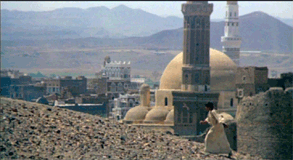 Arabian Nights,
the third film in Pier Palo Pasolini’s “trilogy of life,” (following The
Decameron and The Canterbury Tales) feels as if it’s intoxicated by the
possibilities of storytelling. This anthological film’s multiple narratives
collapse upon each other turning into a labyrinthine tangle that few films,
outside of The Saragossa Manuscript,
manage to match. Stories unfold from within other stories, and everyone seems
equally likely to begin narrating another tale and sending the film off on
another tangent. They flow into each other instead of being separated cleanly.
The Arabian Nights’ roots as oral anecdotes are acknowledged by this plot
structure, and the movie feels wildly random and spontaneous as a result.
Despite the relative simplicity of the tales that are being told, the movie
feels as if it takes place in a world filled with complexities. Perhaps, that
exhilarating confusion arises for Western viewers because the film casts them
into a fictionalized world where traditional rules of Western narrative don’t
apply. Women are active participants in the story instead of passive set
decoration. Chance plays more of a role here in determining a character’s fate
than temperament does. As a result, the tales don’t really end in tragedy or
comedy so much as in an undeniable acknowledgement of an unseen hand that guides
the events in our lives.
Arabian Nights,
the third film in Pier Palo Pasolini’s “trilogy of life,” (following The
Decameron and The Canterbury Tales) feels as if it’s intoxicated by the
possibilities of storytelling. This anthological film’s multiple narratives
collapse upon each other turning into a labyrinthine tangle that few films,
outside of The Saragossa Manuscript,
manage to match. Stories unfold from within other stories, and everyone seems
equally likely to begin narrating another tale and sending the film off on
another tangent. They flow into each other instead of being separated cleanly.
The Arabian Nights’ roots as oral anecdotes are acknowledged by this plot
structure, and the movie feels wildly random and spontaneous as a result.
Despite the relative simplicity of the tales that are being told, the movie
feels as if it takes place in a world filled with complexities. Perhaps, that
exhilarating confusion arises for Western viewers because the film casts them
into a fictionalized world where traditional rules of Western narrative don’t
apply. Women are active participants in the story instead of passive set
decoration. Chance plays more of a role here in determining a character’s fate
than temperament does. As a result, the tales don’t really end in tragedy or
comedy so much as in an undeniable acknowledgement of an unseen hand that guides
the events in our lives.
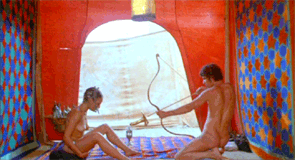 We don’t ever see Scheherazade, Aladdin, or Sinbad during
Pasolini’s adaptation of these classic stories, but the tales that he does opt
to adapt (picked from a group numbering over 400) tell us more about the themes
of the source material than most previous attempts to transfer them to film
have. It’s a widely held misconception that the bulk of the Arabian Nights
stories were aimed at children, but Pasolini’s film does much to debunk that
perception. Many of the tales are sexually charged, and the majority of them
feature characters that engage in intercourse as flippantly, and nearly as
graphically, as actors in a porno movie. Pasolini presents these sex scenes with
total candidness, however, so they never feel exploitative or embarrassing. The
combination of this sexual frankness and tales about subjects that might seem
outwardly puerile (there are stories about a vengeful demon, a bandit queen, and
a slave who becomes king, to name a few) creates a happy medium in which the sex
seems more innocent than it is, and these “children’s stories” are
suddenly made worthy of adult consideration. Pasolini’s Arabian Nights
succeeds mostly because it never assumes neither frank carnality nor flights of
fancy are beneath us.
We don’t ever see Scheherazade, Aladdin, or Sinbad during
Pasolini’s adaptation of these classic stories, but the tales that he does opt
to adapt (picked from a group numbering over 400) tell us more about the themes
of the source material than most previous attempts to transfer them to film
have. It’s a widely held misconception that the bulk of the Arabian Nights
stories were aimed at children, but Pasolini’s film does much to debunk that
perception. Many of the tales are sexually charged, and the majority of them
feature characters that engage in intercourse as flippantly, and nearly as
graphically, as actors in a porno movie. Pasolini presents these sex scenes with
total candidness, however, so they never feel exploitative or embarrassing. The
combination of this sexual frankness and tales about subjects that might seem
outwardly puerile (there are stories about a vengeful demon, a bandit queen, and
a slave who becomes king, to name a few) creates a happy medium in which the sex
seems more innocent than it is, and these “children’s stories” are
suddenly made worthy of adult consideration. Pasolini’s Arabian Nights
succeeds mostly because it never assumes neither frank carnality nor flights of
fancy are beneath us.