|
Newest Reviews:
New Movies -
The Tunnel
V/H/S
The Tall Man
Mama Africa
Detention
Brake
Ted
Tomboy
Brownian Movement
Last Ride
[Rec]³: Genesis
Hara-Kiri: Death of a Samurai
Indie Game: The Movie
Abraham Lincoln: Vampire Hunter
Old Movies -
Touki Bouki: The Journey of the Hyena
Drums Along the Mohawk
The Chase
The Heiress
Show
People
The Strange Affair of Uncle Harry
Pitfall
Driftwood
Miracle Mile
The Great Flamarion
Dark Habits
Archives -
Recap: 2000,
2001, 2002,
2003, 2004
, 2005, 2006,
2007 , 2008
, 2009 ,
2010 , 2011 ,
2012
All reviews alphabetically
All reviews by star rating
All reviews by release year
Masterpieces
Screening Log
Links
FAQ
E-mail me
HOME
| |
The Enigma of Kaspar Hauser (Werner Herzog) 1974
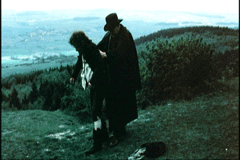 A direct translation of the German title of Werner
Herzog’s The Enigma of Kaspar Hauser
would be Every Man for Himself and God
Against All, but I don’t think that verbose title’s cynicism
encapsulates the breadth of the film’s subject matter. This stunning work
takes Herzog’s most commonly used theme, which basically suggests society and
its trappings corrupt man’s true nature, and uses it to tell this affecting
tale of a man who has been raised in a basement for the first eighteen years of
his life. The power of the performance by Bruno S., an ex-schizophrenic that
Herzog cast as Kaspar, cannot be underestimated here. His flat affect and
emotional simplicity are stunning because they represent what’s probably the
purest individual on screen outside of Dreyer’s Joan of Arc. There seems to be
no illusion in the performance, even though there surely is a good deal of it.
Because of his sheer lack of perspective, Kaspar is in a unique position to
truly reject science, religion, philosophy, and logic. Because of that, the
decency that emerges from him feels like proof of man’s propensity toward
goodness. His eventual defeat becomes profoundly moving because of society’s
failure to recognize him as the testament that he is.
A direct translation of the German title of Werner
Herzog’s The Enigma of Kaspar Hauser
would be Every Man for Himself and God
Against All, but I don’t think that verbose title’s cynicism
encapsulates the breadth of the film’s subject matter. This stunning work
takes Herzog’s most commonly used theme, which basically suggests society and
its trappings corrupt man’s true nature, and uses it to tell this affecting
tale of a man who has been raised in a basement for the first eighteen years of
his life. The power of the performance by Bruno S., an ex-schizophrenic that
Herzog cast as Kaspar, cannot be underestimated here. His flat affect and
emotional simplicity are stunning because they represent what’s probably the
purest individual on screen outside of Dreyer’s Joan of Arc. There seems to be
no illusion in the performance, even though there surely is a good deal of it.
Because of his sheer lack of perspective, Kaspar is in a unique position to
truly reject science, religion, philosophy, and logic. Because of that, the
decency that emerges from him feels like proof of man’s propensity toward
goodness. His eventual defeat becomes profoundly moving because of society’s
failure to recognize him as the testament that he is.
 The most startling thing about Herzog’s vision
here is that Kaspar never feels the least bit Gump-ish.
Herzog never attempts to force us to feel sorry for his protagonist. His
struggles to integrate are presented as problems with our society instead of
problems with this individual. Things become archly comic as we are made to
laugh at our human foibles. How else can we react but by laughing when we are
faced with such huge deficiencies within ourselves? Herzog doesn’t seem to be
damning us throughout, exactly, but his criticisms are that much more biting
because they can be made frankly with a lack of spite. Herzog’s biggest
directorial imposition here is that he uses skewed camera angles and an
ever-present fog to represent Kaspar’s state of confusion. As the parade of
so-called experts attempts to assess Kaspar and pigeonhole his state into
something classifiable, the very notion that any of our accumulated knowledge
means anything begins to crack. That’s no small feat for a mere film to
accomplish, and that Herzog comes awfully close here is an astonishing
achievement. The Enigma of Kaspar Hauser achieves timelessness through
its satire and its sensibilities seem less stodgy than in most period films.
Herzog seems to be snickering at everyone on screen from just outside the frame.
The most startling thing about Herzog’s vision
here is that Kaspar never feels the least bit Gump-ish.
Herzog never attempts to force us to feel sorry for his protagonist. His
struggles to integrate are presented as problems with our society instead of
problems with this individual. Things become archly comic as we are made to
laugh at our human foibles. How else can we react but by laughing when we are
faced with such huge deficiencies within ourselves? Herzog doesn’t seem to be
damning us throughout, exactly, but his criticisms are that much more biting
because they can be made frankly with a lack of spite. Herzog’s biggest
directorial imposition here is that he uses skewed camera angles and an
ever-present fog to represent Kaspar’s state of confusion. As the parade of
so-called experts attempts to assess Kaspar and pigeonhole his state into
something classifiable, the very notion that any of our accumulated knowledge
means anything begins to crack. That’s no small feat for a mere film to
accomplish, and that Herzog comes awfully close here is an astonishing
achievement. The Enigma of Kaspar Hauser achieves timelessness through
its satire and its sensibilities seem less stodgy than in most period films.
Herzog seems to be snickering at everyone on screen from just outside the frame.
* * * *
01-30-02
Jeremy Heilman
|
