|
Newest Reviews:
New Movies -
The Tunnel
V/H/S
The Tall Man
Mama Africa
Detention
Brake
Ted
Tomboy
Brownian Movement
Last Ride
[Rec]³: Genesis
Hara-Kiri: Death of a Samurai
Indie Game: The Movie
Abraham Lincoln: Vampire Hunter
Old Movies -
Touki Bouki: The Journey of the Hyena
Drums Along the Mohawk
The Chase
The Heiress
Show
People
The Strange Affair of Uncle Harry
Pitfall
Driftwood
Miracle Mile
The Great Flamarion
Dark Habits
Archives -
Recap: 2000,
2001, 2002,
2003, 2004
, 2005, 2006,
2007 , 2008
, 2009 ,
2010 , 2011 ,
2012
All reviews alphabetically
All reviews by star rating
All reviews by release year
Masterpieces
Screening Log
Links
FAQ
E-mail me
HOME
| |
The Story of Adele H. (François Truffaut) 1975
 Based on the writings of Adele, the daughter of the great
French writer Victor Hugo, François Truffaut’s The Story of Adele H.
is gifted with an unusual sense of intelligence. That the film is based on
actual events is not allowed to escape past the audience. A series of maps and
titles at the start of the film explain the historical context that this story
takes place in. The treatment of this most unusual tale of romantic obsession is
always restrained enough to keep it from feeling like a conventional movie
melodrama. Few scenes escalate into histrionics, and most are defensible because
the events in them have been taken from existing documentation. Adele’s diary,
her correspondence with her father, military logs, and a most important
newspaper announcement are the only fragments of these lives’ events, but they
are enough, it seems to gather a reasonable understanding of these people.
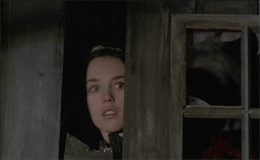
Isabelle Adjani, who plays Adele in a remarkable, Oscar-nominated performance, remains
enough of a clean slate that Truffaut can’t be accused of attempting to alter
history to suit his dramatic purposes. Still, the rare glimpses that we get into
her psyche tell us enough about her feelings that we stay compelled. Adjani is
so uncommonly pretty and smart at the start of the film that her degeneration
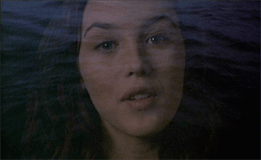
manages to catch us completely off guard. She doesn't just have a break down:
she disintegrates, and since she's in nearly every shot of the film, we have no
choice but to follow her.
Based on the writings of Adele, the daughter of the great
French writer Victor Hugo, François Truffaut’s The Story of Adele H.
is gifted with an unusual sense of intelligence. That the film is based on
actual events is not allowed to escape past the audience. A series of maps and
titles at the start of the film explain the historical context that this story
takes place in. The treatment of this most unusual tale of romantic obsession is
always restrained enough to keep it from feeling like a conventional movie
melodrama. Few scenes escalate into histrionics, and most are defensible because
the events in them have been taken from existing documentation. Adele’s diary,
her correspondence with her father, military logs, and a most important
newspaper announcement are the only fragments of these lives’ events, but they
are enough, it seems to gather a reasonable understanding of these people.
Isabelle Adjani, who plays Adele in a remarkable, Oscar-nominated performance, remains
enough of a clean slate that Truffaut can’t be accused of attempting to alter
history to suit his dramatic purposes. Still, the rare glimpses that we get into
her psyche tell us enough about her feelings that we stay compelled. Adjani is
so uncommonly pretty and smart at the start of the film that her degeneration
manages to catch us completely off guard. She doesn't just have a break down:
she disintegrates, and since she's in nearly every shot of the film, we have no
choice but to follow her.
 As I previously noted, The Story of Adele H. is
remarkably intelligent. Most scenes affect the audience in numerous ways. We see
the pathos in Adele’s affections, but there is also a sense of comedy in them
since her repressed life has resulted in a hunger so insatiable that it nearly
destroys her. We note that the obsession that consumes Adele seems to be only
satisfied by her humiliation, and there’s something perversely laughable and
pathetic about her bullheadedness, especially considering her social status. She
finds her inability to order her lover around inconceivable, even as it drives
her closer toward him. Still, the audience’s ability to analyze Adele in a way
that she herself cannot doesn’t preclude our sympathy toward her, though the
film’s refusal to simplify itself does keep it even from taking off completely
as either a farce or a romance. Sometimes you wish it would just let us cry for
the girl, but emotional easiness such as that would probably make it too
conventional to be worth our interest. Since the movie never does such a thing,
Truffaut’s work in Adele is grudgingly above reproach. It has taken one
of the most clichéd, mind-numbing genres and made something new and exciting
out of it.
As I previously noted, The Story of Adele H. is
remarkably intelligent. Most scenes affect the audience in numerous ways. We see
the pathos in Adele’s affections, but there is also a sense of comedy in them
since her repressed life has resulted in a hunger so insatiable that it nearly
destroys her. We note that the obsession that consumes Adele seems to be only
satisfied by her humiliation, and there’s something perversely laughable and
pathetic about her bullheadedness, especially considering her social status. She
finds her inability to order her lover around inconceivable, even as it drives
her closer toward him. Still, the audience’s ability to analyze Adele in a way
that she herself cannot doesn’t preclude our sympathy toward her, though the
film’s refusal to simplify itself does keep it even from taking off completely
as either a farce or a romance. Sometimes you wish it would just let us cry for
the girl, but emotional easiness such as that would probably make it too
conventional to be worth our interest. Since the movie never does such a thing,
Truffaut’s work in Adele is grudgingly above reproach. It has taken one
of the most clichéd, mind-numbing genres and made something new and exciting
out of it.
* * * 1/2
05-26-02
Jeremy Heilman
|
