Heart of Glass (Werner Herzog) 1976
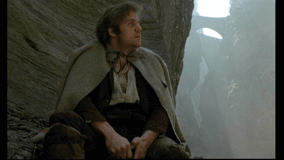 Werner Herzog’s Heart of Glass is a cryptic and astounding piece of
work, but its unfailing elusiveness hardly compromises the apocalyptic overtones
that turn up here. Filled with some flat-out stunning nature cinematography,
that places its events in a global context, the movie feels as if it takes place
in a boundless world, and that sense of expansiveness makes its chronicle of the
downfall of one small 18th-century Bavarian hamlet feel as if its an allegory
about pressing global trends. Most of Herzog’s best films do nothing less than
take challenge the hubris inherent in the concept of civilized life, and Heart
of Glass is no exception. In one of the director’s more idiosyncratic and
audacious stunts, Herzog has all of the actors in Heart of Glass perform
while under hypnosis. The results are decidedly distinctive, if not entirely
successful since the somnambulistic actors’ delivery has a distancing effect.
Still, it’s tough to escape the obvious metaphor inherent in this approach,
and it does give him excuse to include a breathtakingly gorgeous opening in
which he sets the tone, essentially hypnotizing the audience too by asking them
to stare intently into the cascade of a waterfall.
Werner Herzog’s Heart of Glass is a cryptic and astounding piece of
work, but its unfailing elusiveness hardly compromises the apocalyptic overtones
that turn up here. Filled with some flat-out stunning nature cinematography,
that places its events in a global context, the movie feels as if it takes place
in a boundless world, and that sense of expansiveness makes its chronicle of the
downfall of one small 18th-century Bavarian hamlet feel as if its an allegory
about pressing global trends. Most of Herzog’s best films do nothing less than
take challenge the hubris inherent in the concept of civilized life, and Heart
of Glass is no exception. In one of the director’s more idiosyncratic and
audacious stunts, Herzog has all of the actors in Heart of Glass perform
while under hypnosis. The results are decidedly distinctive, if not entirely
successful since the somnambulistic actors’ delivery has a distancing effect.
Still, it’s tough to escape the obvious metaphor inherent in this approach,
and it does give him excuse to include a breathtakingly gorgeous opening in
which he sets the tone, essentially hypnotizing the audience too by asking them
to stare intently into the cascade of a waterfall.
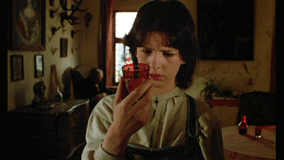 The misty Bavarian landscapes that the most of the events of
the film take place in seem to be perfect cover for secrets, and what little
plot there is in Heart of Glass hinges upon a secret. The people of the
town are set into a tizzy after a master glassmaker dies, taking the technique
used to make a highly valuable kind of rose-colored glass along with him to the
grave. Before long, the economy and society of the town begin to collapse,
allowing Herzog to launch a series of images at us that signify and characterize
the chaos. What’s most wonderful about Herzog’s approach is that he
doesn’t feel it necessary to make sure his images mean anything.
Instead of opting for easy symbolism and puffy visual metaphors, he creates
images that are disturbing not because they stand for something that we find
disturbing, but instead bother us because they are inherently “not right”.
His images are powerful enough to stand on their own. The hypnotized actors only
add to this mood, since they are clearly capable of emoting, but seem almost
robotic in their actions.
The misty Bavarian landscapes that the most of the events of
the film take place in seem to be perfect cover for secrets, and what little
plot there is in Heart of Glass hinges upon a secret. The people of the
town are set into a tizzy after a master glassmaker dies, taking the technique
used to make a highly valuable kind of rose-colored glass along with him to the
grave. Before long, the economy and society of the town begin to collapse,
allowing Herzog to launch a series of images at us that signify and characterize
the chaos. What’s most wonderful about Herzog’s approach is that he
doesn’t feel it necessary to make sure his images mean anything.
Instead of opting for easy symbolism and puffy visual metaphors, he creates
images that are disturbing not because they stand for something that we find
disturbing, but instead bother us because they are inherently “not right”.
His images are powerful enough to stand on their own. The hypnotized actors only
add to this mood, since they are clearly capable of emoting, but seem almost
robotic in their actions.
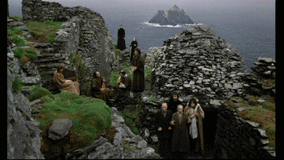 Heart of Glass’ vantage point seems to sympathize
most with Hias, the prophet cowherd that warns the villagers of impending doom.
He seems to see something bad in the future, but the mists of his confusion
obscure it. As such, he recites plaintive jumbles that no one can be bothered to
interpret. That his sanity is questionable is beside the point, since there is
truth to be found in what he says. If Herzog’s filmmaking isn’t quite so
obtuse, it certainly offers as few easy answers as Hias’ divination does. The
glorious ending sequence wraps the allegory in another, casting the film off
with a bitter, beautiful sense of hope. To complain that this mesmerizing film
sometimes drags seems almost infantile in light of its achievements, but
there’s no denying that it does. Because of its utter uniqueness, it’s
expansive vision, and its stone-gazed look at the downfall that very possibly
awaits our race, Heart of Glass is a must-see.
Heart of Glass’ vantage point seems to sympathize
most with Hias, the prophet cowherd that warns the villagers of impending doom.
He seems to see something bad in the future, but the mists of his confusion
obscure it. As such, he recites plaintive jumbles that no one can be bothered to
interpret. That his sanity is questionable is beside the point, since there is
truth to be found in what he says. If Herzog’s filmmaking isn’t quite so
obtuse, it certainly offers as few easy answers as Hias’ divination does. The
glorious ending sequence wraps the allegory in another, casting the film off
with a bitter, beautiful sense of hope. To complain that this mesmerizing film
sometimes drags seems almost infantile in light of its achievements, but
there’s no denying that it does. Because of its utter uniqueness, it’s
expansive vision, and its stone-gazed look at the downfall that very possibly
awaits our race, Heart of Glass is a must-see.
* * * *
05-01-02
Jeremy Heilman
