|
Newest Reviews:
New Movies -
The Tunnel
V/H/S
The Tall Man
Mama Africa
Detention
Brake
Ted
Tomboy
Brownian Movement
Last Ride
[Rec]³: Genesis
Hara-Kiri: Death of a Samurai
Indie Game: The Movie
Abraham Lincoln: Vampire Hunter
Old Movies -
Touki Bouki: The Journey of the Hyena
Drums Along the Mohawk
The Chase
The Heiress
Show
People
The Strange Affair of Uncle Harry
Pitfall
Driftwood
Miracle Mile
The Great Flamarion
Dark Habits
Archives -
Recap: 2000,
2001, 2002,
2003, 2004
, 2005, 2006,
2007 , 2008
, 2009 ,
2010 , 2011 ,
2012
All reviews alphabetically
All reviews by star rating
All reviews by release year
Masterpieces
Screening Log
Links
FAQ
E-mail me
HOME
| |
Sebastiane (Derek Jarman & Paul Humfress, 1976)
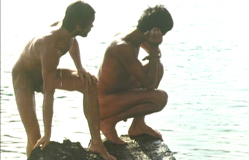 Sebastiane, the cult film that
marked the debut feature by gay experimental filmmaker Derek Jarman, treads an
almost imperceptible line between using devout fidelity to ratify its source and
using rampant infidelity to undermine it. Set in 303 A.D., the film provides a
blow-by-blow account of the exiled Roman soldier, devout Christian, and eventual
Saint Sebastian who is martyred for rejecting the sexual advances of a
commanding officer. After an extended sequence that takes place during a Roman
orgy and recalls Kenneth Anger’s gaudy Inauguration of the Pleasure Dome,
the locale shifts to a remote military outpost, where the rest of the film
unfolds. Similarly to The Gospel According to St. Matthew, also directed
by a gay man, it’s difficult to tell from what’s on screen alone whether or
not Sebastiane is celebrating the Saint or deriding the religion that
chose him as an ideal. Whereas Pasolini’s Gospel used a nearly
neo-realist approach that somewhat obscured his political intentions, Jarman and
his more glitzier style appear to have a clearer agenda. The primary concern of
the film seems to push the boundaries of what’s acceptable on screen. Just as
the old silent Biblical epics allowed filmmakers to legitimize tales that were
laden with sex and violence, Sebastiane uses its context to justify the
presence of copious amounts of full frontal male nudity and characters that
openly have same-sex intercourse.
Sebastiane, the cult film that
marked the debut feature by gay experimental filmmaker Derek Jarman, treads an
almost imperceptible line between using devout fidelity to ratify its source and
using rampant infidelity to undermine it. Set in 303 A.D., the film provides a
blow-by-blow account of the exiled Roman soldier, devout Christian, and eventual
Saint Sebastian who is martyred for rejecting the sexual advances of a
commanding officer. After an extended sequence that takes place during a Roman
orgy and recalls Kenneth Anger’s gaudy Inauguration of the Pleasure Dome,
the locale shifts to a remote military outpost, where the rest of the film
unfolds. Similarly to The Gospel According to St. Matthew, also directed
by a gay man, it’s difficult to tell from what’s on screen alone whether or
not Sebastiane is celebrating the Saint or deriding the religion that
chose him as an ideal. Whereas Pasolini’s Gospel used a nearly
neo-realist approach that somewhat obscured his political intentions, Jarman and
his more glitzier style appear to have a clearer agenda. The primary concern of
the film seems to push the boundaries of what’s acceptable on screen. Just as
the old silent Biblical epics allowed filmmakers to legitimize tales that were
laden with sex and violence, Sebastiane uses its context to justify the
presence of copious amounts of full frontal male nudity and characters that
openly have same-sex intercourse.
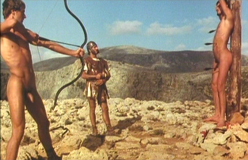 As opposed to the coy talk of oysters
and snails that dotted sword and sandals epics such as Spartacus, Jarman
packs Sebastiane with overt homosexuality. While I’m not versed enough
in the history of the time to say to what degree this portrayal of the
soldiers’ sex lives is historically accurate or embellished by gay wish
fulfillment, within the diegetic world of the film, it makes sense. One suspects
though that historical accuracy was a prime concern here, if only to make a
statement about the factual whitewashing that typically occurs in the genre
(oddly the violence never seems to be excised). The film’s dialogue is all
spoken in Latin and the costumes, while scant, feel believable. The prime
element that seems out of place on historical terms is the effective score,
composed by modern minimalist Brian Eno. Otherwise, Sebastiane’s
production values are more than sufficient to give the impression that the
viewer is watching an actual group of Roman soldiers as they train and frolic.
Though the actors never make the combination of homosexual overtones and a
regimented military lifestyle have the emotional resonance that it did in Claire
Denis’ masterpiece Beau Travail, Sebastiane nonetheless manages
to be a captivating, and titillating, original. As opposed to the coy talk of oysters
and snails that dotted sword and sandals epics such as Spartacus, Jarman
packs Sebastiane with overt homosexuality. While I’m not versed enough
in the history of the time to say to what degree this portrayal of the
soldiers’ sex lives is historically accurate or embellished by gay wish
fulfillment, within the diegetic world of the film, it makes sense. One suspects
though that historical accuracy was a prime concern here, if only to make a
statement about the factual whitewashing that typically occurs in the genre
(oddly the violence never seems to be excised). The film’s dialogue is all
spoken in Latin and the costumes, while scant, feel believable. The prime
element that seems out of place on historical terms is the effective score,
composed by modern minimalist Brian Eno. Otherwise, Sebastiane’s
production values are more than sufficient to give the impression that the
viewer is watching an actual group of Roman soldiers as they train and frolic.
Though the actors never make the combination of homosexual overtones and a
regimented military lifestyle have the emotional resonance that it did in Claire
Denis’ masterpiece Beau Travail, Sebastiane nonetheless manages
to be a captivating, and titillating, original.
* * * 1/2
06-05-03
Jeremy Heilman
|
