There are those who will react negatively to the abundant
symbolism of Robert Altman’s dreamlike fugue 3 Women, since the pieces in this puzzle movie haven’t been
fashioned to fit together perfectly, and there are those who will relish the
experience of simply playing the game, and not care about the end result. I’m
definitely one of the latter types, and found its challenges easy to embrace.
Altman claims that the film’s inspiration came to him in a dream, and that
feels appropriate even it’s a bit of an embellishment, since he creates here
otherworldly tone sets in from the start, and puts us in an associative,
detached state where we are more willing to accept and less likely to question.
The first shots of the movie are cast behind an undulating wave of water, and
throughout the film, the image of water is used to represent entrance into a
dream state. Early on, when Shelly Duvall’s Millie guides Sissy Spacek’s
Pinky into a wading pool, they are literally submerged into that dream world,
and they don’t seem to come out for the rest of the film.
There are hints before this scene that point toward what
Altman’s after here, but it would take an unusually astute viewer to pick up
on them. In the opening moments of the movie, the hopelessly meek Pinky, who has
just relocated to the film’s Southern California setting from Texas, can be
seen watching and eavesdropping on the women who work at the health spa where
she works. Since we’re watching Pinky as she is observing others, we’re
implicated as viewers since we’re voyeuristically watching her. Since decoding
the movie’s symbolism requires an active viewer, it creates an unshakable
feeling that we’re asking the same questions that Altman is. It feels as if
we’re working through the movie’s mystery at the same pace as the director.
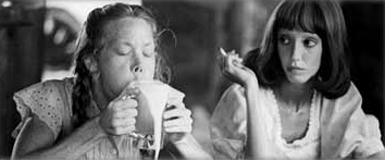
When no one else is looking at Pinky, we see still are, and we get to see her
behaving differently than she does in front of others. She blows bubbles in her
Coke and does wheelies in a wheelchair. From the first reel, Altman is trying to
examine what it is that lays under the exterior that women project. Not
surprisingly, what we find is less comforting than we might like.
The characters in the movie seem to talk as if they have
wholly unchecked ids. At first, when we observe this behavior in Pinky and
Millie, we take it as nervousness, since the two have just met, but it continues
to extend beyond them. Everyone from the fascist supervisors at the spa and the
hospital to the openly rude neighbors in Millie’s apartment complex seems to
speak their mind just a tad too freely to be believable. The movie seems to be
set in some alternate universe where people’s interior thoughts just ribbon
out of them in conversation. The movie might not have a conventional narrative,
but it has a certain something about it that’s amazingly entrancing, and
whatever else it might be, it’s certainly not clichéd. There’s a
surprisingly lively sense of humor tossed in with the psychodrama, and Altman
never lets things get too heavy or pretentious, even as his inflates his simple
gender politics beyond their usefulness. Better yet, he uses most of his
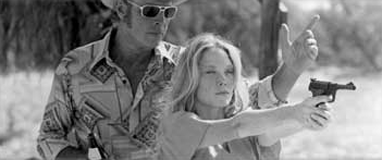
humorous touches to further enhance our understanding of the characters.He mocks the film’s dominant male by having him brag about his status
as ex-stunt double to an actor who played a cowboy. He underlines the social
inadequacy of Pinky and Millie by showing their elaborate and inane preparations
for a dinner party.
3 Women is
marked with a distinctly dusty haziness that suggests there are always a few
layers of distortion between what we’re seeing and reality. Altman often
shoots through objects, such as a chain link fence, a soap scum covered mirror,
an aquarium, and a screen door, so we never feel comfortable taking an image at
face value. The spare flute solos add to the sense of mystery. Often, instead of
cutting at the end of a scene, he uses a dissolve, adding to the dreamy allure
of the movie. The images flow into each other, and soon begin to recall each
other as we progress (regress?) deeper into the minds of the titular characters.
If we feel at first unable to express what it is about some of the shots and
imagery in the film that feels off, by the end of the film, we feel justified in
feeling that way, even if we still can’t quite explain it. Altman’s style
and subject here is an obvious predecessor to David Lynch’s Mulholland
Dr., but it also recalls Bergman’s Persona,
and it ranks alongside either in the pantheon of great films about dreams.