
|
|
|
Newest Reviews: New Movies - Abraham Lincoln: Vampire Hunter Old Movies - Touki Bouki: The Journey of the Hyena The Strange Affair of Uncle Harry Archives - Recap: 2000, 2001, 2002, 2003, 2004 , 2005, 2006, 2007 , 2008 , 2009 , 2010 , 2011 , 2012
|
Autumn Sonata (Ingmar Bergman) 1978 Autumn
Sonata, a stunningly accomplished chamber drama from Ingmar Bergman, is
relaxed as often as it is austere. Set mostly in a country home, the film
essentially has three speaking parts, and the real crux of the film revolves
around only two of the characters, an emotionally and physically distant mother
and daughter. Played respectively by Ingrid Bergman (as Charlotte) and Liv
Ullmann (as Eva), the two actresses give phenomenal performances. After seven
years apart, the death of Charlotte’s longtime companion prompts Eva to invite
her to her home, and the film observes the way that the physical and temporal
distance from their relationship has in no way dulled the acute feelings that
they have about each other.
Much of the film feels
like a condemnation of Charlotte, who was more devoted to her work than her
daughter, and it’s shocking that Bergman would be so one-sided. It’s quite
apparent that the scars of Eva’s childhood haven’t been left behind. Some of
her complaints, while essentially valid (a mother should be perceptive toward
her daughter’s feelings), seem a bit unfounded (an adult should be able to
accept that her mother is human as well, foibles and all). As Eva continues to
eviscerate her mother for her neglect, the audience’s resentment toward Eva
builds up for doling out the punishment, making us better understand where
Eva’s coming from. The film doesn’t exactly take sides, but there is the
feeling that Charlotte, who did have an affair, is getting a bum rap from a
woman that claims to be incapable of love herself, yet is married. We certainly
can acknowledge Charlotte’s guilt, but this war being waged on Eva’s home
turf feels a bit unfair.
* * * * 01/18/02 Jeremy Heilman
|
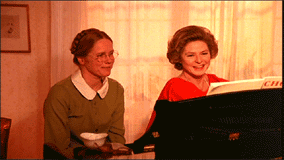 Watching a good Bergman movie is like being thrown into a
psychic vortex. The way that the director uses the screen to represent the state
of mind of his characters is truly unparalleled. His camera stresses the
unspoken but rarely appears to (notice the camera’s slightest recoil when the
mother and daughter embrace in bed). His close-ups are held for inordinately
long periods and the emotions that wash over the face of his actors have a
genuine complexity and depth to them. They don’t often say exactly what they
are feeling, but we understand implicitly. Everything that we see is intimate,
but there are even more layers suggested that are never revealed. In some of her
writings, Eva mentions that she values feeling without sentimentality, and
that's precisely what a Bergman film provides.
Watching a good Bergman movie is like being thrown into a
psychic vortex. The way that the director uses the screen to represent the state
of mind of his characters is truly unparalleled. His camera stresses the
unspoken but rarely appears to (notice the camera’s slightest recoil when the
mother and daughter embrace in bed). His close-ups are held for inordinately
long periods and the emotions that wash over the face of his actors have a
genuine complexity and depth to them. They don’t often say exactly what they
are feeling, but we understand implicitly. Everything that we see is intimate,
but there are even more layers suggested that are never revealed. In some of her
writings, Eva mentions that she values feeling without sentimentality, and
that's precisely what a Bergman film provides. 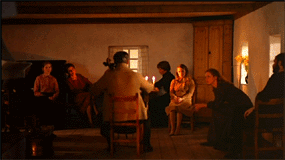 It’s to Bergman’s credit, then, that the last two minutes completely dispel
any such complaint. With striking economy, the film suggests there will be a
winter to follow this relationship’s autumn, and if the tone isn’t exactly
hopeful, it’s certainly open to the possibility of hope. Impossibly pretty,
the film is shot by Sven Nykvist in autumnal hues and impressionistic lighting
with flashbacks that look more like animated paintings than mere sets.
Bergman’s technical brilliance is subdued here, allowing his actors and script
to leave the biggest impressions. If the humble Autumn
Sonata ultimately lacks the sheer power of Bergman’s similarly constrained
Cries and Whispers or Persona,
it is only because its admirable earthiness needn’t resort to the former’s
transcendent leaps into the supernatural and the latter’s narrative
explosions.
It’s to Bergman’s credit, then, that the last two minutes completely dispel
any such complaint. With striking economy, the film suggests there will be a
winter to follow this relationship’s autumn, and if the tone isn’t exactly
hopeful, it’s certainly open to the possibility of hope. Impossibly pretty,
the film is shot by Sven Nykvist in autumnal hues and impressionistic lighting
with flashbacks that look more like animated paintings than mere sets.
Bergman’s technical brilliance is subdued here, allowing his actors and script
to leave the biggest impressions. If the humble Autumn
Sonata ultimately lacks the sheer power of Bergman’s similarly constrained
Cries and Whispers or Persona,
it is only because its admirable earthiness needn’t resort to the former’s
transcendent leaps into the supernatural and the latter’s narrative
explosions.