|
Newest Reviews:
New Movies -
The Tunnel
V/H/S
The Tall Man
Mama Africa
Detention
Brake
Ted
Tomboy
Brownian Movement
Last Ride
[Rec]³: Genesis
Hara-Kiri: Death of a Samurai
Indie Game: The Movie
Abraham Lincoln: Vampire Hunter
Old Movies -
Touki Bouki: The Journey of the Hyena
Drums Along the Mohawk
The Chase
The Heiress
Show
People
The Strange Affair of Uncle Harry
Pitfall
Driftwood
Miracle Mile
The Great Flamarion
Dark Habits
Archives -
Recap: 2000,
2001, 2002,
2003, 2004
, 2005, 2006,
2007 , 2008
, 2009 ,
2010 , 2011 ,
2012
All reviews alphabetically
All reviews by star rating
All reviews by release year
Masterpieces
Screening Log
Links
FAQ
E-mail me
HOME
| |
Heaven’s
Gate (Michael Cimino) 1980
 Critically mauled upon its initial release, partially due to its contemplative
pacing and gargantuan budget and partly because its first theatrical release was
seventy minutes shorter than the director intended, Michael Cimino’s elegiac
western Heaven’s Gate is actually a
powerful and surprisingly focused work. Cimino’s methodical attention to
detail and slow plotting pay dividends throughout since the director is as
interested in understanding the tensions that led to the Johnson County War of
1890, in which a group of immigrants deemed thieves were hunted down by a
corporation, as the actual presentation of the battle. Even more impressive than
the film’s meticulous detail, though, is that the film’s technical
obsessions never comes at the expense of emotional intimacy. By the end of the
film’s lengthy (3 hour and 40 minute) running time, we thoroughly understand
the plight of both the immigrant farmers and the stockholders at the center of
this story. What becomes startling, then, is the inability to clearly draw lines
and declare who is right and wrong. Even if the villains occasionally do a bit
too much moustache-twirling for the picture’s good, a surprising amount of the
film’s morality falls into a gray area.
Critically mauled upon its initial release, partially due to its contemplative
pacing and gargantuan budget and partly because its first theatrical release was
seventy minutes shorter than the director intended, Michael Cimino’s elegiac
western Heaven’s Gate is actually a
powerful and surprisingly focused work. Cimino’s methodical attention to
detail and slow plotting pay dividends throughout since the director is as
interested in understanding the tensions that led to the Johnson County War of
1890, in which a group of immigrants deemed thieves were hunted down by a
corporation, as the actual presentation of the battle. Even more impressive than
the film’s meticulous detail, though, is that the film’s technical
obsessions never comes at the expense of emotional intimacy. By the end of the
film’s lengthy (3 hour and 40 minute) running time, we thoroughly understand
the plight of both the immigrant farmers and the stockholders at the center of
this story. What becomes startling, then, is the inability to clearly draw lines
and declare who is right and wrong. Even if the villains occasionally do a bit
too much moustache-twirling for the picture’s good, a surprising amount of the
film’s morality falls into a gray area.

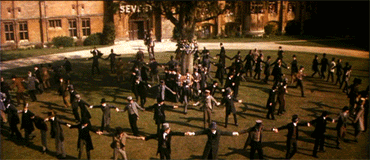 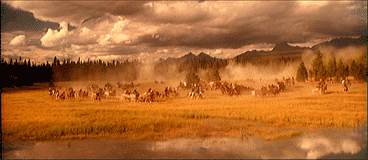
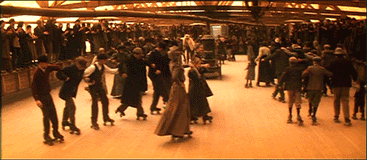 Visually, Cimino finds a way to convey this moral struggle by keeping his film
duskily perched between day and night. The sepia tinged images and grainy film
stock suggest a nostalgic yearning, but it takes a while to understand that
what’s being mourned isn’t simply an idealized vision of the Wild West.
Instead the movie laments the death of the dreams of those colonists who came to
America with aspirations of a better life. The oppression that they find in the
New World, instead of being religious, is financial. Their crimes are crimes of
need, stealing as they do, so their family can eat (though Cimino wisely takes
time to show these same immigrants as they are drinking and gambling). The
eventual insurrection is at once the release to the pressures that have been
building throughout the film and senseless resolution of absolutely nothing.
It’s telling that when Cimino stages a whirling skirmish near the film’s
end, he observes it from enough distance that its wild circular motion resembles
both the dances at the Harvard graduation at the film’s start and the roller
derby line dance that the migrant workers engage in at the film’s midway
point. With his standoffish perspective, Cimino shows us the mechanical
similarities between these events, allowing us to glimpse a natural order in
things normally portrayed as chaotic. He poetically underscores the events of
his film with images like this time and again, making the denouement at once
horribly shocking and inevitably obvious. If the standoff at Heaven’s Gate
feels inevitable, than the realization little has changed in American class
structure lends the film a
surprising amount of modern day relevancy. Whatever might be said about the
film, it certainly isn’t a waste of time. Because of its ambition, the film is
sometimes sloppy, but that sloppiness is forgivable because it’s the exalted,
compelling kind.
Visually, Cimino finds a way to convey this moral struggle by keeping his film
duskily perched between day and night. The sepia tinged images and grainy film
stock suggest a nostalgic yearning, but it takes a while to understand that
what’s being mourned isn’t simply an idealized vision of the Wild West.
Instead the movie laments the death of the dreams of those colonists who came to
America with aspirations of a better life. The oppression that they find in the
New World, instead of being religious, is financial. Their crimes are crimes of
need, stealing as they do, so their family can eat (though Cimino wisely takes
time to show these same immigrants as they are drinking and gambling). The
eventual insurrection is at once the release to the pressures that have been
building throughout the film and senseless resolution of absolutely nothing.
It’s telling that when Cimino stages a whirling skirmish near the film’s
end, he observes it from enough distance that its wild circular motion resembles
both the dances at the Harvard graduation at the film’s start and the roller
derby line dance that the migrant workers engage in at the film’s midway
point. With his standoffish perspective, Cimino shows us the mechanical
similarities between these events, allowing us to glimpse a natural order in
things normally portrayed as chaotic. He poetically underscores the events of
his film with images like this time and again, making the denouement at once
horribly shocking and inevitably obvious. If the standoff at Heaven’s Gate
feels inevitable, than the realization little has changed in American class
structure lends the film a
surprising amount of modern day relevancy. Whatever might be said about the
film, it certainly isn’t a waste of time. Because of its ambition, the film is
sometimes sloppy, but that sloppiness is forgivable because it’s the exalted,
compelling kind.
*
* * *
3/25/02
Jeremy
Heilman
|
