|
Newest Reviews:
New Movies -
The Tunnel
V/H/S
The Tall Man
Mama Africa
Detention
Brake
Ted
Tomboy
Brownian Movement
Last Ride
[Rec]³: Genesis
Hara-Kiri: Death of a Samurai
Indie Game: The Movie
Abraham Lincoln: Vampire Hunter
Old Movies -
Touki Bouki: The Journey of the Hyena
Drums Along the Mohawk
The Chase
The Heiress
Show
People
The Strange Affair of Uncle Harry
Pitfall
Driftwood
Miracle Mile
The Great Flamarion
Dark Habits
Archives -
Recap: 2000,
2001, 2002,
2003, 2004
, 2005, 2006,
2007 , 2008
, 2009 ,
2010 , 2011 ,
2012
All reviews alphabetically
All reviews by star rating
All reviews by release year
Masterpieces
Screening Log
Links
FAQ
E-mail me
HOME
| |
The Long Good Friday (John Mackenzie) 1982
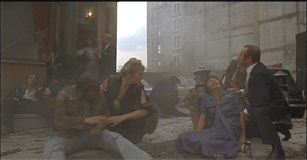 Bob Hoskins gives a stunning, doggedly tough yet profoundly
pained performance in John Mackenzie’s London-based gangster flick The
Long Good Friday that sometimes manages to elevate the picture’s generally
diffuse drama to Shakespearean levels. Hoskins is perfectly cast, as his
physical presence seems to be at odds with the well groomed world he’s
maneuvering in here. Helen Mirren, who’s really quite elegant and beautiful
here, exudes such class as his trophy wife that the feeling that Hoskins is a
trespasser in the straight world is only aggrandized by her presence. He might
try to look like a businessman, but it’s all too apparent that he’s a paunch
little thug under the business suit. It’s a testament to the actor’s ability
that the film manages to work as well as it does, since the tone is often
hackneyed and cumbersome. Mackenzie stages the opening minutes without dialogue
which, leaves the audience needlessly puzzled about what was shown there for
much of the running time. After the dialogue kicks in, a drone of jarringly
inappropriate synthesized music chimes in regularly to eliminate much of the
atmosphere as it is forming. Nevertheless, outside of Guy Richie, there hasn’t
been an overabundance of British gangster films lately, so the locale helps a
lot of what we see still feel fresh.
Bob Hoskins gives a stunning, doggedly tough yet profoundly
pained performance in John Mackenzie’s London-based gangster flick The
Long Good Friday that sometimes manages to elevate the picture’s generally
diffuse drama to Shakespearean levels. Hoskins is perfectly cast, as his
physical presence seems to be at odds with the well groomed world he’s
maneuvering in here. Helen Mirren, who’s really quite elegant and beautiful
here, exudes such class as his trophy wife that the feeling that Hoskins is a
trespasser in the straight world is only aggrandized by her presence. He might
try to look like a businessman, but it’s all too apparent that he’s a paunch
little thug under the business suit. It’s a testament to the actor’s ability
that the film manages to work as well as it does, since the tone is often
hackneyed and cumbersome. Mackenzie stages the opening minutes without dialogue
which, leaves the audience needlessly puzzled about what was shown there for
much of the running time. After the dialogue kicks in, a drone of jarringly
inappropriate synthesized music chimes in regularly to eliminate much of the
atmosphere as it is forming. Nevertheless, outside of Guy Richie, there hasn’t
been an overabundance of British gangster films lately, so the locale helps a
lot of what we see still feel fresh.
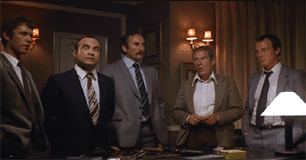 Harold, Hoskin’s character, is undoubtedly a high roller
in London’s regimented gangster world, but when the shit starts to come down,
he feels remarkably wounded. Unlike most films in this genre, he stops to mourn
his fallen friends. The script allows him to feel scared, confused, and angry
when a gang war appears to be bubbling up from under the surface of the London
streets. Much of that gang war is obscured from us, as the film tends to stick
with Howard, the leader of his faction, and not with the thugs. Still, when it
comes time for him to show it, Howard’s brutality rises up from just under the
surface and slashes out at those around him. Howard’s professional exterior is
put on here, not incidentally, to impress a group of Americans, and the entire
film feels like an examination of British reserve and its breaking point. It
doesn’t just seem to be his vocation that gives Howard such a chip on his
shoulder, as his nationality definitely feels like a factor. Howard’s wife and
he spend the film catering to the Americans, keeping up appearances, and when
the events that are pressuring Howard finally push him out of the realm of good
manners and understatement, it results, not surprisingly, in a tragedy. The
terrific final scene feels less like a return to reserve than a retreat to
resignation. The complexity of Howard’s character becomes far more interesting
than the plot ever does. We’re always more trapped in the moment with Howard
than aware of the machinations that are conspiring against him. Hoskin’s
exceptional performance is good enough to make this muck through the genre’s
cliches worthwhile, though.
Harold, Hoskin’s character, is undoubtedly a high roller
in London’s regimented gangster world, but when the shit starts to come down,
he feels remarkably wounded. Unlike most films in this genre, he stops to mourn
his fallen friends. The script allows him to feel scared, confused, and angry
when a gang war appears to be bubbling up from under the surface of the London
streets. Much of that gang war is obscured from us, as the film tends to stick
with Howard, the leader of his faction, and not with the thugs. Still, when it
comes time for him to show it, Howard’s brutality rises up from just under the
surface and slashes out at those around him. Howard’s professional exterior is
put on here, not incidentally, to impress a group of Americans, and the entire
film feels like an examination of British reserve and its breaking point. It
doesn’t just seem to be his vocation that gives Howard such a chip on his
shoulder, as his nationality definitely feels like a factor. Howard’s wife and
he spend the film catering to the Americans, keeping up appearances, and when
the events that are pressuring Howard finally push him out of the realm of good
manners and understatement, it results, not surprisingly, in a tragedy. The
terrific final scene feels less like a return to reserve than a retreat to
resignation. The complexity of Howard’s character becomes far more interesting
than the plot ever does. We’re always more trapped in the moment with Howard
than aware of the machinations that are conspiring against him. Hoskin’s
exceptional performance is good enough to make this muck through the genre’s
cliches worthwhile, though.
* * *
12-06-01
Jeremy Heilman
|
