|
Newest Reviews:
New Movies -
The Tunnel
V/H/S
The Tall Man
Mama Africa
Detention
Brake
Ted
Tomboy
Brownian Movement
Last Ride
[Rec]³: Genesis
Hara-Kiri: Death of a Samurai
Indie Game: The Movie
Abraham Lincoln: Vampire Hunter
Old Movies -
Touki Bouki: The Journey of the Hyena
Drums Along the Mohawk
The Chase
The Heiress
Show
People
The Strange Affair of Uncle Harry
Pitfall
Driftwood
Miracle Mile
The Great Flamarion
Dark Habits
Archives -
Recap: 2000,
2001, 2002,
2003, 2004
, 2005, 2006,
2007 , 2008
, 2009 ,
2010 , 2011 ,
2012
All reviews alphabetically
All reviews by star rating
All reviews by release year
Masterpieces
Screening Log
Links
FAQ
E-mail me
HOME
| |
Streets of Fire (Walter Hill, 1984)
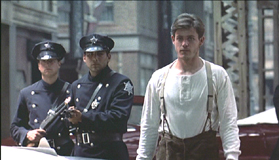 Underrated action director Walter Hill
reaches aesthetic heights that he’s rarely matched in 1984’s lively
kidnapping drama Streets of Fire. Perhaps best described as an improved
amalgamation of John Carpenter’s Escape From New York and Hill’s own The
Warriors re-imagined as a careening rock opera, the movie enters territory
that’s certainly playful by the hard-edged director’s standards. The results
are a movie that is unabashedly fluent in pop culture terminology, and not
afraid to exaggerate its notions of hipness or downplay its expectations of
realism to thrill us. In construction, it resembles a comic book as much as it
does a music video, and, at least on the surface, has about as much on its mind
as either. It’s rare to see a modern movie that’s so deliriously, obviously
fake. With a massive, fabricated backlot standing in for city streets and a cast
of wonderfully outsized characters (I love McCoy, the butch female sidekick), Streets
of Fire clearly takes place in a world that could only be found in the
movies. This makes the movie a pleasurable experience for those who crave the
elements of genre cinema that more readily lend themselves to escapism. Perhaps,
then, it’s not surprising that the music that plays during this film’s
climactic show-off resurfaces in Tarantino’s Pulp Fiction. Underrated action director Walter Hill
reaches aesthetic heights that he’s rarely matched in 1984’s lively
kidnapping drama Streets of Fire. Perhaps best described as an improved
amalgamation of John Carpenter’s Escape From New York and Hill’s own The
Warriors re-imagined as a careening rock opera, the movie enters territory
that’s certainly playful by the hard-edged director’s standards. The results
are a movie that is unabashedly fluent in pop culture terminology, and not
afraid to exaggerate its notions of hipness or downplay its expectations of
realism to thrill us. In construction, it resembles a comic book as much as it
does a music video, and, at least on the surface, has about as much on its mind
as either. It’s rare to see a modern movie that’s so deliriously, obviously
fake. With a massive, fabricated backlot standing in for city streets and a cast
of wonderfully outsized characters (I love McCoy, the butch female sidekick), Streets
of Fire clearly takes place in a world that could only be found in the
movies. This makes the movie a pleasurable experience for those who crave the
elements of genre cinema that more readily lend themselves to escapism. Perhaps,
then, it’s not surprising that the music that plays during this film’s
climactic show-off resurfaces in Tarantino’s Pulp Fiction.
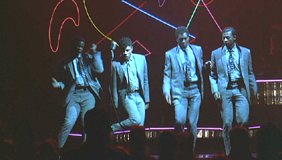 Hill’s skill in this genre pays off in
the expected ways. Characters largely defined through action. There are few
unnecessary subplots. The pacing is snappy and efficient. It becomes apparent
while watching, however, in a lot of ways, this is less an “action movie”
than a “motion movie”, since the director is able to find the same kinetic
thrills in his dialogue scenes, musical numbers, and establishing shots as in
his brawls. With Hill’s evolved, MTV-style editing (does anyone use wipes more
readily?) and willingness to let the soundtrack enhance the action, the fusion
between the propulsive pop music and the mobile camera create an elated swirl of
screen momentum. The end result is a movie that could only have been made in the
‘80s, but somehow maintains its virtues in the present day. As much as the
film is stuck with a mid-1980s definition of cool (think MeatLoaf songs and
Stevie Nicks), it benefits from a retro-futuristic look that makes it tough to
place it definitively in any time period. As action adventures go, Streets of
Fire is a likable achievement. With its lively spirit and its unpretentious
attitude toward the craft, it delivers on all of the promises it makes. Hill’s skill in this genre pays off in
the expected ways. Characters largely defined through action. There are few
unnecessary subplots. The pacing is snappy and efficient. It becomes apparent
while watching, however, in a lot of ways, this is less an “action movie”
than a “motion movie”, since the director is able to find the same kinetic
thrills in his dialogue scenes, musical numbers, and establishing shots as in
his brawls. With Hill’s evolved, MTV-style editing (does anyone use wipes more
readily?) and willingness to let the soundtrack enhance the action, the fusion
between the propulsive pop music and the mobile camera create an elated swirl of
screen momentum. The end result is a movie that could only have been made in the
‘80s, but somehow maintains its virtues in the present day. As much as the
film is stuck with a mid-1980s definition of cool (think MeatLoaf songs and
Stevie Nicks), it benefits from a retro-futuristic look that makes it tough to
place it definitively in any time period. As action adventures go, Streets of
Fire is a likable achievement. With its lively spirit and its unpretentious
attitude toward the craft, it delivers on all of the promises it makes.
71
04-06-04
Jeremy Heilman
|
