|
Newest Reviews:
New Movies -
The Tunnel
V/H/S
The Tall Man
Mama Africa
Detention
Brake
Ted
Tomboy
Brownian Movement
Last Ride
[Rec]³: Genesis
Hara-Kiri: Death of a Samurai
Indie Game: The Movie
Abraham Lincoln: Vampire Hunter
Old Movies -
Touki Bouki: The Journey of the Hyena
Drums Along the Mohawk
The Chase
The Heiress
Show
People
The Strange Affair of Uncle Harry
Pitfall
Driftwood
Miracle Mile
The Great Flamarion
Dark Habits
Archives -
Recap: 2000,
2001, 2002,
2003, 2004
, 2005, 2006,
2007 , 2008
, 2009 ,
2010 , 2011 ,
2012
All reviews alphabetically
All reviews by star rating
All reviews by release year
Masterpieces
Screening Log
Links
FAQ
E-mail me
HOME
| |
Candyman (Bernard Rose) 1992
 Bernard Rose’s Candyman, based on a Clive Barker short
story, is the mythic sort of horror / art film combination that is usually
referenced in reviews of films that hew too closely to one of those elements to
be successful as both. There’s plenty to be scared of in this film. Tony Todd
plays the titular character with a menacing and imposing presence. In the
original short story, Candyman was jaundiced and white, but the film’s
decision to cast a black man pays dividends. The locale has also been shifted
from Britain to Chicago’s Cabrini section, which ensures that not all of the
reasons for Helen, the film’s protagonist, to be afraid are supernatural. As
the lone white woman in a housing project, she is placing herself in danger
regardless of the presence of spooks. Because of this, the film builds a tension
that the audience can relate to, since much of the threat is grounded in
reality. When the otherworldly Candyman strikes, the significant presence of
blood and gore doesn’t revolt so much as it raises the tension that already
existed. After we see blood spilled the fears that Helen has become grounded,
even if she’s wrong about what she should be afraid of. It would almost feel
racist if Helen weren’t given a black friend (played by director Kasi Lemmons)
who shares her fears. As a result, the film’s prejudices feel borne out of
differences in class, sex, and level of education. Bernard Rose’s Candyman, based on a Clive Barker short
story, is the mythic sort of horror / art film combination that is usually
referenced in reviews of films that hew too closely to one of those elements to
be successful as both. There’s plenty to be scared of in this film. Tony Todd
plays the titular character with a menacing and imposing presence. In the
original short story, Candyman was jaundiced and white, but the film’s
decision to cast a black man pays dividends. The locale has also been shifted
from Britain to Chicago’s Cabrini section, which ensures that not all of the
reasons for Helen, the film’s protagonist, to be afraid are supernatural. As
the lone white woman in a housing project, she is placing herself in danger
regardless of the presence of spooks. Because of this, the film builds a tension
that the audience can relate to, since much of the threat is grounded in
reality. When the otherworldly Candyman strikes, the significant presence of
blood and gore doesn’t revolt so much as it raises the tension that already
existed. After we see blood spilled the fears that Helen has become grounded,
even if she’s wrong about what she should be afraid of. It would almost feel
racist if Helen weren’t given a black friend (played by director Kasi Lemmons)
who shares her fears. As a result, the film’s prejudices feel borne out of
differences in class, sex, and level of education.
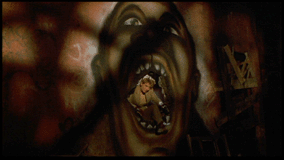 The film’s art-house pretensions gain credence due to the
subject matter. The opening sequence, with its Phillip Glass-penned theme and
striking imagery, places Candyman into
an otherworldliness that is extended when we aren’t sure that what’s on
screen is real, and not just the delusions of the protagonist, whose sanity is
in question. The film’s apparent directorial excesses, which include voiceover
narration and some striking non-narrative shots of bees and skylines, are all
placed in context here, so they don’t feel unnecessary. In fact they keep the
film from sliding into the stupefyingly literal. Candyman proposes to Helen a
world of exquisite pain, and Rose’s images justify that vision by showing us
the inherent beauty in things that are generally regarded as grotesque. As a
result the film sustains a mixture of class and disgust, and there’s a
terrific scene where Helen is mortified to discover her high-priced condo is
actually a converted housing project that drives that dichotomy home. Out of an
excellent cast, Virginia Madsen stands out as Helen, imbuing her character with
such poise and intelligence that when she is able to make the events of the
film’s second half feel truly degrading. Since the movie is set in the world
of academia and follows a grad student, neither its text about urban legends nor
its perceptions of class feel preachy as much as unformed. Candyman is an exemplary example of the horror film’s potential,
though subsequent films in the series have failed to retain a sliver of its
intelligent appeal.
The film’s art-house pretensions gain credence due to the
subject matter. The opening sequence, with its Phillip Glass-penned theme and
striking imagery, places Candyman into
an otherworldliness that is extended when we aren’t sure that what’s on
screen is real, and not just the delusions of the protagonist, whose sanity is
in question. The film’s apparent directorial excesses, which include voiceover
narration and some striking non-narrative shots of bees and skylines, are all
placed in context here, so they don’t feel unnecessary. In fact they keep the
film from sliding into the stupefyingly literal. Candyman proposes to Helen a
world of exquisite pain, and Rose’s images justify that vision by showing us
the inherent beauty in things that are generally regarded as grotesque. As a
result the film sustains a mixture of class and disgust, and there’s a
terrific scene where Helen is mortified to discover her high-priced condo is
actually a converted housing project that drives that dichotomy home. Out of an
excellent cast, Virginia Madsen stands out as Helen, imbuing her character with
such poise and intelligence that when she is able to make the events of the
film’s second half feel truly degrading. Since the movie is set in the world
of academia and follows a grad student, neither its text about urban legends nor
its perceptions of class feel preachy as much as unformed. Candyman is an exemplary example of the horror film’s potential,
though subsequent films in the series have failed to retain a sliver of its
intelligent appeal.
* * * *
Jeremy Heilman
12-14-01
|
