Abre los Ojos (Open Your Eyes) (Alejandro Amenabar) 1997
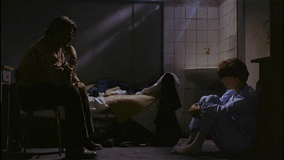 This second feature by Spanish director Alejandro Amenabar, Abre los Ojos
(Open Your Eyes) is a virtual remake of Hitchcock's Vertigo. Like
that film, it dazzles us for a good portion of its running time by never letting
us know exactly where we stand. Both films share a questioning of reality as
they slide deeper and deeper into the lead's obsession. In the film's
first half, it's the hazy trip hop soundtrack and symbolically heavy imagery
keep us guessing. When the hidden truth behind what is going on is revealed with
about 45 minutes of running time left, the film, like Vertigo, changes
into a study of its lead character's twisted psyche.
This second feature by Spanish director Alejandro Amenabar, Abre los Ojos
(Open Your Eyes) is a virtual remake of Hitchcock's Vertigo. Like
that film, it dazzles us for a good portion of its running time by never letting
us know exactly where we stand. Both films share a questioning of reality as
they slide deeper and deeper into the lead's obsession. In the film's
first half, it's the hazy trip hop soundtrack and symbolically heavy imagery
keep us guessing. When the hidden truth behind what is going on is revealed with
about 45 minutes of running time left, the film, like Vertigo, changes
into a study of its lead character's twisted psyche.
 Amenabar does some exciting things here. The film's plot, without spoiling
anything, follows Cesar, the film's lead, a womanizer that is currently involved
with two women. Soon after spending the night and falling in love with one of
them, his reality begins to become confused. During the film's first half,
Cesar is our guide into his Lynchian dream world. The audience's confusions are
shared and amplified by the protagonist. We feel our vision of reality sliding
away with Cesar's. We go insane with him. When the film morphs however (in a
scene where Cesar's friend tells him he's coming undone), and Amenabar all but
reveals the reason behind the madness, our sympathies shift. We stay a step
ahead of Cesar, allowing us to not only observe his psyche, but watch as
Amenabar lectures us about the fragile level of reality that exists in any film.
The way that he keeps us questioning what is real (even though we know nothing
that we see in the film is real) is brilliant. At the end, we can not even be
sure that the film's final fade-out returns us to reality.
Amenabar does some exciting things here. The film's plot, without spoiling
anything, follows Cesar, the film's lead, a womanizer that is currently involved
with two women. Soon after spending the night and falling in love with one of
them, his reality begins to become confused. During the film's first half,
Cesar is our guide into his Lynchian dream world. The audience's confusions are
shared and amplified by the protagonist. We feel our vision of reality sliding
away with Cesar's. We go insane with him. When the film morphs however (in a
scene where Cesar's friend tells him he's coming undone), and Amenabar all but
reveals the reason behind the madness, our sympathies shift. We stay a step
ahead of Cesar, allowing us to not only observe his psyche, but watch as
Amenabar lectures us about the fragile level of reality that exists in any film.
The way that he keeps us questioning what is real (even though we know nothing
that we see in the film is real) is brilliant. At the end, we can not even be
sure that the film's final fade-out returns us to reality.
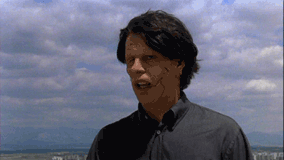 The film lacks the effortlessness that Vertigo has though. It does
rely on a bit of narrative hokum in order to tie these two disparate halves of
film together. Eduardo Noriega's Cesar doesn't quite manage to create the tragic
humanity that Jimmy Stewart does in Vertigo, either. Nonetheless, it is
far more ambitious and timely a remake of that film than something like De
Palma's Obsession. In some ways, it goes farther into the realm of sexual
obsession than Vertigo did, or could dream of doing. What is certain is
that Amenabar, at 25, has created a film that deserves comparison to Hitchcock's
best work.
The film lacks the effortlessness that Vertigo has though. It does
rely on a bit of narrative hokum in order to tie these two disparate halves of
film together. Eduardo Noriega's Cesar doesn't quite manage to create the tragic
humanity that Jimmy Stewart does in Vertigo, either. Nonetheless, it is
far more ambitious and timely a remake of that film than something like De
Palma's Obsession. In some ways, it goes farther into the realm of sexual
obsession than Vertigo did, or could dream of doing. What is certain is
that Amenabar, at 25, has created a film that deserves comparison to Hitchcock's
best work.
****
September, 2001
Jeremy Heilman
