|
Newest Reviews:
New Movies -
The Tunnel
V/H/S
The Tall Man
Mama Africa
Detention
Brake
Ted
Tomboy
Brownian Movement
Last Ride
[Rec]³: Genesis
Hara-Kiri: Death of a Samurai
Indie Game: The Movie
Abraham Lincoln: Vampire Hunter
Old Movies -
Touki Bouki: The Journey of the Hyena
Drums Along the Mohawk
The Chase
The Heiress
Show
People
The Strange Affair of Uncle Harry
Pitfall
Driftwood
Miracle Mile
The Great Flamarion
Dark Habits
Archives -
Recap: 2000,
2001, 2002,
2003, 2004
, 2005, 2006,
2007 , 2008
, 2009 ,
2010 , 2011 ,
2012
All reviews alphabetically
All reviews by star rating
All reviews by release year
Masterpieces
Screening Log
Links
FAQ
E-mail me
HOME
| |
Midnight in the Garden of Good and Evil (Clint Eastwood,
1997)
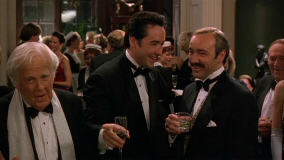 I’ve avoided viewing Clint
Eastwood’s adaptation of John Berendt’s Midnight in the Garden of Good
and Evil for a few years now, even though his previous film, The Bridges
of Madison County, similarly adapted from a book that didn’t seem
obviously destined for greatness on the screen, is my favorite of his works.
Upon watching it, though, it’s obvious that my fears of a bungled adaptation
were misguided. Even though the script adds a token love interest and
necessarily condenses the events in Berendt’s book, this enjoyable, local
color-infused dawdle is a success. It’s an effective motion picture, both as a
travelogue and as a demonstration of director's pragmatic politics. It's
precisely because Eastwood spends so much time helping us to understand the
workings of the minds of small-town Gerogia society that when the film subtly
shifts into message movie mode its suggestion of tolerance it doesn't hammer us
over the head. In what’s likely the movie’s key scene, defense attorney
Sonny Seiler addresses his jury and infers that the price of one’s own
personal freedom is the agreement to allow freedom to others to live as they
choose. Even though the meandering film contains seemingly disparate plot
threads and characters, when they’re all filtered through this central
assertion, the movie feels remarkably cohesive, and the quirky charms of its
Savannah setting grow deeper, because the director’s investment in them
becomes clear. I’ve avoided viewing Clint
Eastwood’s adaptation of John Berendt’s Midnight in the Garden of Good
and Evil for a few years now, even though his previous film, The Bridges
of Madison County, similarly adapted from a book that didn’t seem
obviously destined for greatness on the screen, is my favorite of his works.
Upon watching it, though, it’s obvious that my fears of a bungled adaptation
were misguided. Even though the script adds a token love interest and
necessarily condenses the events in Berendt’s book, this enjoyable, local
color-infused dawdle is a success. It’s an effective motion picture, both as a
travelogue and as a demonstration of director's pragmatic politics. It's
precisely because Eastwood spends so much time helping us to understand the
workings of the minds of small-town Gerogia society that when the film subtly
shifts into message movie mode its suggestion of tolerance it doesn't hammer us
over the head. In what’s likely the movie’s key scene, defense attorney
Sonny Seiler addresses his jury and infers that the price of one’s own
personal freedom is the agreement to allow freedom to others to live as they
choose. Even though the meandering film contains seemingly disparate plot
threads and characters, when they’re all filtered through this central
assertion, the movie feels remarkably cohesive, and the quirky charms of its
Savannah setting grow deeper, because the director’s investment in them
becomes clear.
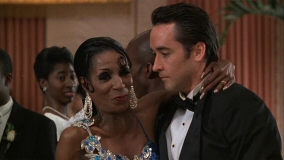 Eastwood doesn’t necessarily endorse
Jim Williams, the film’s homosexual subject, so much as he seems to view him
as a test case for his own tolerance. Unlike the town, Eastwood has no
objections to the man’s sexuality, but he recoils at his slippery refusal to
tell the truth about the murder he’s committed (behavior which the
superficially genteel townspeople fully expect). Kevin Spacey gives an
exceptional performance as Williams, relaying, as the film’s title suggests,
his suave side as much as his slimy one, and in doing so sets the tone for the
rest of the cast. Eastwood views Williams, like all of the residents of Savannah
that we meet, with a mixture of humor and bewilderment. The community is a
mixture of sophistication and superstition, a place where open secrets thrive,
and it throws New York-based protagonist and director’s surrogate John Berendt
(John Cusack) for a loop as much as it seems to bemuse the director. A casual
movie that always threatens to plod, but never quite can be accused of doing so,
Midnight in the Garden of Good and Evil’s location shooting,
diversionary, seemingly inconsequential skits, and unique flavor of the story
cohere into a mixture somewhat greater than the sum of its impressive parts. Eastwood doesn’t necessarily endorse
Jim Williams, the film’s homosexual subject, so much as he seems to view him
as a test case for his own tolerance. Unlike the town, Eastwood has no
objections to the man’s sexuality, but he recoils at his slippery refusal to
tell the truth about the murder he’s committed (behavior which the
superficially genteel townspeople fully expect). Kevin Spacey gives an
exceptional performance as Williams, relaying, as the film’s title suggests,
his suave side as much as his slimy one, and in doing so sets the tone for the
rest of the cast. Eastwood views Williams, like all of the residents of Savannah
that we meet, with a mixture of humor and bewilderment. The community is a
mixture of sophistication and superstition, a place where open secrets thrive,
and it throws New York-based protagonist and director’s surrogate John Berendt
(John Cusack) for a loop as much as it seems to bemuse the director. A casual
movie that always threatens to plod, but never quite can be accused of doing so,
Midnight in the Garden of Good and Evil’s location shooting,
diversionary, seemingly inconsequential skits, and unique flavor of the story
cohere into a mixture somewhat greater than the sum of its impressive parts.
70
05-05-05
Jeremy Heilman
|
