Dancer in the Dark (Lars Von Trier) 2000
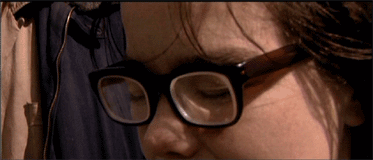 I think the diverse critical reactions to Dancer in the Dark show that the
film was largely misinterpreted. In order to understand what von Trier was trying
to do with this film, it's probably necessary that the title should not simply
be taken literally. The "Dancer in the Dark" in question is also the
light from the projector dancing on the movie screen. The narrative here seems
somewhat controversial, but it's nearly disposable. The story is an excuse for
Von Trier to pay tribute to The Passion of Joan of Arc, probably the best
Danish film ever made. Selma's story is ultimately a tribute to the power of
cinema.
I think the diverse critical reactions to Dancer in the Dark show that the
film was largely misinterpreted. In order to understand what von Trier was trying
to do with this film, it's probably necessary that the title should not simply
be taken literally. The "Dancer in the Dark" in question is also the
light from the projector dancing on the movie screen. The narrative here seems
somewhat controversial, but it's nearly disposable. The story is an excuse for
Von Trier to pay tribute to The Passion of Joan of Arc, probably the best
Danish film ever made. Selma's story is ultimately a tribute to the power of
cinema.
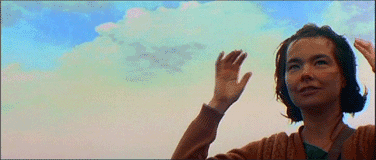 Selma loves musicals (perhaps the most cinematic of all genres), and through
her perseverance in her belief that "nothing dreadful ever happens" in
a musical, she comes to be rewarded. Von Trier allows us to understand her
plight & sympathize with her, but also creates a plot that's clearly meant
to be seen as narrative construct (as opposed to a plausible chain of events).
The wonderful acting convinces us that these characters are real, but at the
same time, they are all played by characters that are cast against type making
us ever aware of the artificiality of the film. Furthermore, all of the
characters actively voice their opinions on film musicals. In the film,
"reality" is shown via shaky handheld digital Dogma-esque camerawork,
but the "fantasy" sequences use a color palette that makes them appear
even more real than the "real" scenes. By the end of the film, the
"real" scenes are being filmed with the "fantasy" camera. By
that point, for Selma, and for the audience, reality and "fantasy" (or
cinema) have converged.
Selma loves musicals (perhaps the most cinematic of all genres), and through
her perseverance in her belief that "nothing dreadful ever happens" in
a musical, she comes to be rewarded. Von Trier allows us to understand her
plight & sympathize with her, but also creates a plot that's clearly meant
to be seen as narrative construct (as opposed to a plausible chain of events).
The wonderful acting convinces us that these characters are real, but at the
same time, they are all played by characters that are cast against type making
us ever aware of the artificiality of the film. Furthermore, all of the
characters actively voice their opinions on film musicals. In the film,
"reality" is shown via shaky handheld digital Dogma-esque camerawork,
but the "fantasy" sequences use a color palette that makes them appear
even more real than the "real" scenes. By the end of the film, the
"real" scenes are being filmed with the "fantasy" camera. By
that point, for Selma, and for the audience, reality and "fantasy" (or
cinema) have converged.



Note von Trier's use of color to separate "fantasy"
from "reality". Near the film's end, the distinctions blur.
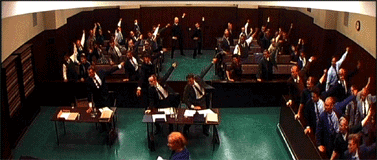 What von Trier's doing here is making us realize what Selma surely realizes.
Although films are just films, they contain a very real ability to create an
alternate reality filled with genuine emotion. While I personally find all this
film theory exceptionally interesting, the great thing is that we can surely
look at the film from a strictly melodramatic / musical perspective, and it
still works quite well. Bjork's performance is absolutely incredible. It
basically achieves its goal of being an equal to Falconetti's in The Passion
of Joan of Arc. The musical score is innovative, complex, and well
integrated into the story. The plot's got a great deal of emotional heft to it,
but never descends into mindless sentimentalism.
What von Trier's doing here is making us realize what Selma surely realizes.
Although films are just films, they contain a very real ability to create an
alternate reality filled with genuine emotion. While I personally find all this
film theory exceptionally interesting, the great thing is that we can surely
look at the film from a strictly melodramatic / musical perspective, and it
still works quite well. Bjork's performance is absolutely incredible. It
basically achieves its goal of being an equal to Falconetti's in The Passion
of Joan of Arc. The musical score is innovative, complex, and well
integrated into the story. The plot's got a great deal of emotional heft to it,
but never descends into mindless sentimentalism.
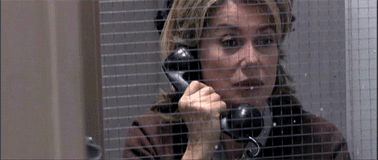 Dancer in the Dark
has taken some flak because its musical sequences have been filmed with still
cameras that obscure some of the choreography. To me, the missing
footage's lack is felt, but that deficiency endows the entire film with an even
greater sense of loss. That movie cameras can't quite capture the glory of the
musical in Selma's head makes us appreciate it all the more. Dancer in the
Dark is the best film by a director that has several
masterpieces under his belt already. It's the best film of its year (2000), and
deserved the Palm D'Or it won at Cannes. It sums up our cinematic experience
better than nearly any film does, and could hold its place as the best film of the
new millennium for quite some time.
Dancer in the Dark
has taken some flak because its musical sequences have been filmed with still
cameras that obscure some of the choreography. To me, the missing
footage's lack is felt, but that deficiency endows the entire film with an even
greater sense of loss. That movie cameras can't quite capture the glory of the
musical in Selma's head makes us appreciate it all the more. Dancer in the
Dark is the best film by a director that has several
masterpieces under his belt already. It's the best film of its year (2000), and
deserved the Palm D'Or it won at Cannes. It sums up our cinematic experience
better than nearly any film does, and could hold its place as the best film of the
new millennium for quite some time.
**** Masterpiece
September, 2001
Jeremy Heilman
