|
Newest Reviews:
New Movies -
The Tunnel
V/H/S
The Tall Man
Mama Africa
Detention
Brake
Ted
Tomboy
Brownian Movement
Last Ride
[Rec]³: Genesis
Hara-Kiri: Death of a Samurai
Indie Game: The Movie
Abraham Lincoln: Vampire Hunter
Old Movies -
Touki Bouki: The Journey of the Hyena
Drums Along the Mohawk
The Chase
The Heiress
Show
People
The Strange Affair of Uncle Harry
Pitfall
Driftwood
Miracle Mile
The Great Flamarion
Dark Habits
Archives -
Recap: 2000,
2001, 2002,
2003, 2004
, 2005, 2006,
2007 , 2008
, 2009 ,
2010 , 2011 ,
2012
All reviews alphabetically
All reviews by star rating
All reviews by release year
Masterpieces
Screening Log
Links
FAQ
E-mail me
HOME
| |
Tears of the Black Tiger (Wisit Sartsanatieng) 2000
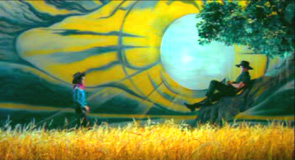 Near the beginning of Thai director Wisit Sartsanatieng’s
wild western Tears of the Black Tiger, a hyperkinetic gun stunt flits by,
but then the movie pauses to toss up a title card reading, “Did you catch
that? If not, we’ll play it again!” Immediately, a more detailed
play-by-play of the ricocheting bullet antics flashes by on the screen, with an
even gorier finish at the end. That sort of energy is contagious, and Tears
seizes upon it in nearly every facet of its design. The colors seem brighter
than should be possible in a movie (or is it just that most other filmmakers hew
too closely to realism?), the set design is filled with so many anachronisms
that I soon gave up trying to place the film into a time period (though I’d
guess it’s just after WWII), the acting is alternatively hammy and sincere,
and the soundtrack is alternatively dominated by traditional love ballads and
twangy banjo anthems. Looking less like the films that it nods toward than the
colorful posters that advertised them, Tiger is filled with rosy cheeks,
pink lips, and a never-ending series of stunning vistas. The juxtapositions seem
randomly chosen at first, but Sartsanatieng shows enough restraint to turn them
into a genuine aesthetic by the end of the first act.
Near the beginning of Thai director Wisit Sartsanatieng’s
wild western Tears of the Black Tiger, a hyperkinetic gun stunt flits by,
but then the movie pauses to toss up a title card reading, “Did you catch
that? If not, we’ll play it again!” Immediately, a more detailed
play-by-play of the ricocheting bullet antics flashes by on the screen, with an
even gorier finish at the end. That sort of energy is contagious, and Tears
seizes upon it in nearly every facet of its design. The colors seem brighter
than should be possible in a movie (or is it just that most other filmmakers hew
too closely to realism?), the set design is filled with so many anachronisms
that I soon gave up trying to place the film into a time period (though I’d
guess it’s just after WWII), the acting is alternatively hammy and sincere,
and the soundtrack is alternatively dominated by traditional love ballads and
twangy banjo anthems. Looking less like the films that it nods toward than the
colorful posters that advertised them, Tiger is filled with rosy cheeks,
pink lips, and a never-ending series of stunning vistas. The juxtapositions seem
randomly chosen at first, but Sartsanatieng shows enough restraint to turn them
into a genuine aesthetic by the end of the first act.
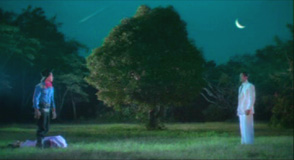 With a simple story that pays homage to Spaghetti Westerns,
and the mood of old-school Asian tearjerkers, this tale of Dum, a legendary
gunslinger who never misses his target, and Rumpoey, his upper-class childhood
sweetheart, has plenty of room for stylistic flights of fancy. Often flirting
with garishness, the film rarely disappoints on visual grounds, but the
surprising thing about it is how tightly conceived the plot is. Clearly designed
as a crowd-pleaser, Tears doesn’t dig for subtlety or weighty themes,
but that hardly hampers a movie that has so many superficial pleasures to glean.
The romantic moments are as effective as the action-packed ones, and in both
cases the film revels in its melodramatic flair. A great deal of borrowing is
done from other films in picking the types of characters used here and the
situations devised, but few genre pictures aren’t guilty of the same. Besides,
when pastiche is assembled with as much excitement as it is here, it gains
distinct energy of its own. Perhaps the best way to describe Tears is to
say that it seems to be the sort of film that Japan’s Takashi Miike is capable
of making as soon as he develops a slightly longer attention span, and that’s
no slight compliment.
With a simple story that pays homage to Spaghetti Westerns,
and the mood of old-school Asian tearjerkers, this tale of Dum, a legendary
gunslinger who never misses his target, and Rumpoey, his upper-class childhood
sweetheart, has plenty of room for stylistic flights of fancy. Often flirting
with garishness, the film rarely disappoints on visual grounds, but the
surprising thing about it is how tightly conceived the plot is. Clearly designed
as a crowd-pleaser, Tears doesn’t dig for subtlety or weighty themes,
but that hardly hampers a movie that has so many superficial pleasures to glean.
The romantic moments are as effective as the action-packed ones, and in both
cases the film revels in its melodramatic flair. A great deal of borrowing is
done from other films in picking the types of characters used here and the
situations devised, but few genre pictures aren’t guilty of the same. Besides,
when pastiche is assembled with as much excitement as it is here, it gains
distinct energy of its own. Perhaps the best way to describe Tears is to
say that it seems to be the sort of film that Japan’s Takashi Miike is capable
of making as soon as he develops a slightly longer attention span, and that’s
no slight compliment.
* * * 1/2
11-11-02
Jeremy Heilman
|
