|
Newest Reviews:
New Movies -
The Tunnel
V/H/S
The Tall Man
Mama Africa
Detention
Brake
Ted
Tomboy
Brownian Movement
Last Ride
[Rec]³: Genesis
Hara-Kiri: Death of a Samurai
Indie Game: The Movie
Abraham Lincoln: Vampire Hunter
Old Movies -
Touki Bouki: The Journey of the Hyena
Drums Along the Mohawk
The Chase
The Heiress
Show
People
The Strange Affair of Uncle Harry
Pitfall
Driftwood
Miracle Mile
The Great Flamarion
Dark Habits
Archives -
Recap: 2000,
2001, 2002,
2003, 2004
, 2005, 2006,
2007 , 2008
, 2009 ,
2010 , 2011 ,
2012
All reviews alphabetically
All reviews by star rating
All reviews by release year
Masterpieces
Screening Log
Links
FAQ
E-mail me
HOME
| |
CQ (Roman Coppola) 2001
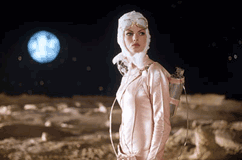 Roman Coppola’s debut feature CQ begins as a
promising mod-style romp through Paris, 1969, but as it progresses, the film
begins to unravel. Under the guise of an intensely personal chronicle of an
aspiring filmmaker’s attempts to cope with personal and professional stresses,
the movie unfortunately reveals itself to be a relatively empty exercise in some
very stylish style. The accomplished opening scenes of the film establish Paul
(Jeremy Davies) as an editor on the crew of a troubled campy science fiction
picture entitled Dragonfly (worry not – there’s no relation to this year’s
Kevin Costner train wreck). A colorful supporting cast is introduced which
includes Gerard Depardieu as a maniacally obsessive auteur director, Jason
Schwartzman as Felix DeMarco, his enfant terrible replacement, a hilarious
Giancarlo Giannini as a blustery De Laurentiis-style producer (he pronounces
Felix’s name in a way that makes it sound like “phallics”), Angela
Lindvall as the film’s femme fatale action hero, and Elodie Bouchez as
Paul’s flight attendant girlfriend. It initially feels as if we’ve been cast
into a Fellini-esque world of absurd caricatures, and that tone seems right for
a movie that chronicles the wild frenzy of filmmaking (after all, it worked in 8
1/2). Unfortunately, after the initial thrill of Coppola’s visuals dies
down, we’re left with a mimetic approximation of better films like Godard’s Contempt.
Roman Coppola’s debut feature CQ begins as a
promising mod-style romp through Paris, 1969, but as it progresses, the film
begins to unravel. Under the guise of an intensely personal chronicle of an
aspiring filmmaker’s attempts to cope with personal and professional stresses,
the movie unfortunately reveals itself to be a relatively empty exercise in some
very stylish style. The accomplished opening scenes of the film establish Paul
(Jeremy Davies) as an editor on the crew of a troubled campy science fiction
picture entitled Dragonfly (worry not – there’s no relation to this year’s
Kevin Costner train wreck). A colorful supporting cast is introduced which
includes Gerard Depardieu as a maniacally obsessive auteur director, Jason
Schwartzman as Felix DeMarco, his enfant terrible replacement, a hilarious
Giancarlo Giannini as a blustery De Laurentiis-style producer (he pronounces
Felix’s name in a way that makes it sound like “phallics”), Angela
Lindvall as the film’s femme fatale action hero, and Elodie Bouchez as
Paul’s flight attendant girlfriend. It initially feels as if we’ve been cast
into a Fellini-esque world of absurd caricatures, and that tone seems right for
a movie that chronicles the wild frenzy of filmmaking (after all, it worked in 8
1/2). Unfortunately, after the initial thrill of Coppola’s visuals dies
down, we’re left with a mimetic approximation of better films like Godard’s Contempt.
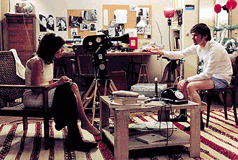 It doesn’t help matters much that the films that Paul is
involved in (besides the silly romp Dragonfly, he’s also composing an
indulgent and intimate black and white look at his life) are less than
inspiring. Perhaps the most revealing scene about Paul’s abilities occurs when
he whines to his girlfriend, “I just want to capture what’s real and
honest,” and she replies, “But what if it’s boring?” There’s much
excitement about the future of the medium manifested in Dragonfly’s
science fiction trappings (and the ending seems to prematurely announce the
arrival of a major new talent), but the film seems blissfully unaware that by
1969, most of the stylistic innovators that prompted the New Wave had already
peaked. This might be partially because of the often bandied about, but hard to
support, theory that the 70’s, brought forth an even greater era in cinematic
history – one that was fronted by Roman Coppola’s father. Nashville, The
Godfather, and Five Easy Pieces are fine films, to be sure, but
they’re nowhere near the breakthroughs of great 60’s movies like 2001: A
Space Odyssey, Bonnie & Clyde, Persona, Breathless,
Jules and Jim, and L’Amour Fou. It’s tough to be involved with
the artist’s dilemma when it’s so self-serving as it is here, and just
because a director wants to make a personal film without compromises, doesn’t
mean that the audience has to accept it. For all of CQ's talk about the
importance of a stellar ending, Coppola doesn't seem able to give his debut a
satisfying one. Clearly, the young director has potential as a
filmmaker, but I don’t think this film is much of a successful expression of
his talent. In CQ he’s clearly bitten off more than he can chew.
It doesn’t help matters much that the films that Paul is
involved in (besides the silly romp Dragonfly, he’s also composing an
indulgent and intimate black and white look at his life) are less than
inspiring. Perhaps the most revealing scene about Paul’s abilities occurs when
he whines to his girlfriend, “I just want to capture what’s real and
honest,” and she replies, “But what if it’s boring?” There’s much
excitement about the future of the medium manifested in Dragonfly’s
science fiction trappings (and the ending seems to prematurely announce the
arrival of a major new talent), but the film seems blissfully unaware that by
1969, most of the stylistic innovators that prompted the New Wave had already
peaked. This might be partially because of the often bandied about, but hard to
support, theory that the 70’s, brought forth an even greater era in cinematic
history – one that was fronted by Roman Coppola’s father. Nashville, The
Godfather, and Five Easy Pieces are fine films, to be sure, but
they’re nowhere near the breakthroughs of great 60’s movies like 2001: A
Space Odyssey, Bonnie & Clyde, Persona, Breathless,
Jules and Jim, and L’Amour Fou. It’s tough to be involved with
the artist’s dilemma when it’s so self-serving as it is here, and just
because a director wants to make a personal film without compromises, doesn’t
mean that the audience has to accept it. For all of CQ's talk about the
importance of a stellar ending, Coppola doesn't seem able to give his debut a
satisfying one. Clearly, the young director has potential as a
filmmaker, but I don’t think this film is much of a successful expression of
his talent. In CQ he’s clearly bitten off more than he can chew.
* *
05-27-02
Jeremy Heilman
|
