|
Newest Reviews:
New Movies -
The Tunnel
V/H/S
The Tall Man
Mama Africa
Detention
Brake
Ted
Tomboy
Brownian Movement
Last Ride
[Rec]³: Genesis
Hara-Kiri: Death of a Samurai
Indie Game: The Movie
Abraham Lincoln: Vampire Hunter
Old Movies -
Touki Bouki: The Journey of the Hyena
Drums Along the Mohawk
The Chase
The Heiress
Show
People
The Strange Affair of Uncle Harry
Pitfall
Driftwood
Miracle Mile
The Great Flamarion
Dark Habits
Archives -
Recap: 2000,
2001, 2002,
2003, 2004
, 2005, 2006,
2007 , 2008
, 2009 ,
2010 , 2011 ,
2012
All reviews alphabetically
All reviews by star rating
All reviews by release year
Masterpieces
Screening Log
Links
FAQ
E-mail me
HOME
| |
Stanley Kubrick: A Life in Pictures (Jan Harlan) 2001
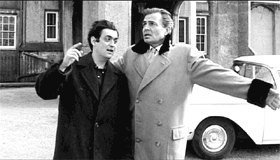 Perhaps because its subject’s brother-in-law directed it
and perhaps because it feels as if Warner Bros. has bankrolled it, Jan
Harlan’s adulatory documentary Stanley Kubrick: A Life in Pictures
gives the impression at times that filmic history is being rewritten before our
eyes. That’s not to imply that it’s not put together well. The two and a
half hour running time flies by quickly, and the many exclusive interviews
included provide some genuine insight into the man behind such landmark films as
2001. Kubrick’s story and attitudes are so well known by cineastes that
the only way a feature without grand factual revelations about the man can make
his tale seem fresh is by providing first hand accounts of working with the man,
so this documentary’s flaws don’t lie in its approach. Tracing his career
and personal life chronologically from birth until death, the film certainly
serves well as a refresher course to those familiar with the director’s works.
For those who haven’t seen Kubrick’s oeuvre, it might prove a detrimental
viewing experience, however, since several of his movies’ endings are freely
spoiled.
Perhaps because its subject’s brother-in-law directed it
and perhaps because it feels as if Warner Bros. has bankrolled it, Jan
Harlan’s adulatory documentary Stanley Kubrick: A Life in Pictures
gives the impression at times that filmic history is being rewritten before our
eyes. That’s not to imply that it’s not put together well. The two and a
half hour running time flies by quickly, and the many exclusive interviews
included provide some genuine insight into the man behind such landmark films as
2001. Kubrick’s story and attitudes are so well known by cineastes that
the only way a feature without grand factual revelations about the man can make
his tale seem fresh is by providing first hand accounts of working with the man,
so this documentary’s flaws don’t lie in its approach. Tracing his career
and personal life chronologically from birth until death, the film certainly
serves well as a refresher course to those familiar with the director’s works.
For those who haven’t seen Kubrick’s oeuvre, it might prove a detrimental
viewing experience, however, since several of his movies’ endings are freely
spoiled.
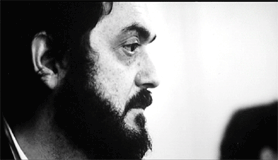 I’m no Kubrick scholar, having only a slightly above
average knowledge of his work, but the portrayal of the director offered in this
film still seemed suspect to me. The most glaring omission is the fact that
Kubrick was fired from the production of the Marlon Brando vehicle One-Eyed
Jacks (1961). Coming as it did after the director’s clashes with Kirk
Douglas on the set of Spartacus, this experience must have been
instrumental in Kubrick’s decision to insist upon total creative control on
his future projects. To gloss over the experience entirely is to ignore a major
event in the director’s development. Any problems with historical accuracy
seem less severe when compared to the film’s simple-minded deification of its
subject, however. In the film’s eyes, Kubrick never made a film that was
anything less than a masterpiece. Any interviewees that might have criticized
his work have been shuttled off-screen. His decision to remove several of his
early films from circulation is never really called into question. The way that
narrator Tom Cruise intones “his only Oscar ever” as he describes his 2001
Special Effects award win makes the slight sound tantamount to a cardinal sin.
Furthermore, there is a repeated insistence that Kubrick was an utterly normal,
social, and congenial guy. Obviously, the myth of Stanley Kubrick has overtaken
the reality of Stanley Kubrick, but the doggedness expressed in debunking the
perception that Kubrick was a hermit soon becomes tiresome, and a bit silly,
frankly. I enjoy Kubrick’s films as much as anyone, but I simply don’t
understand the need to make his genius more human.
I am perfectly content to approach his intelligence like the black monoliths in 2001:
able to appreciate it, but not sure that I'll ever fully understand it except as something other
than my own.
I’m no Kubrick scholar, having only a slightly above
average knowledge of his work, but the portrayal of the director offered in this
film still seemed suspect to me. The most glaring omission is the fact that
Kubrick was fired from the production of the Marlon Brando vehicle One-Eyed
Jacks (1961). Coming as it did after the director’s clashes with Kirk
Douglas on the set of Spartacus, this experience must have been
instrumental in Kubrick’s decision to insist upon total creative control on
his future projects. To gloss over the experience entirely is to ignore a major
event in the director’s development. Any problems with historical accuracy
seem less severe when compared to the film’s simple-minded deification of its
subject, however. In the film’s eyes, Kubrick never made a film that was
anything less than a masterpiece. Any interviewees that might have criticized
his work have been shuttled off-screen. His decision to remove several of his
early films from circulation is never really called into question. The way that
narrator Tom Cruise intones “his only Oscar ever” as he describes his 2001
Special Effects award win makes the slight sound tantamount to a cardinal sin.
Furthermore, there is a repeated insistence that Kubrick was an utterly normal,
social, and congenial guy. Obviously, the myth of Stanley Kubrick has overtaken
the reality of Stanley Kubrick, but the doggedness expressed in debunking the
perception that Kubrick was a hermit soon becomes tiresome, and a bit silly,
frankly. I enjoy Kubrick’s films as much as anyone, but I simply don’t
understand the need to make his genius more human.
I am perfectly content to approach his intelligence like the black monoliths in 2001:
able to appreciate it, but not sure that I'll ever fully understand it except as something other
than my own.
* * 1/2
4-16-02
Jeremy Heilman
|
