
|
|
|
Newest Reviews: New Movies - Abraham Lincoln: Vampire Hunter Old Movies - Touki Bouki: The Journey of the Hyena The Strange Affair of Uncle Harry Archives - Recap: 2000, 2001, 2002, 2003, 2004 , 2005, 2006, 2007 , 2008 , 2009 , 2010 , 2011 , 2012
|
I'm Going Home (Manoel de Oliveira) 2002
After this flash forward, the director sets up a routine in Gilbert's life. We see him window shopping and returning daily to the same cafe. He continues his work onstage (we now see him in a production of The Tempest) as he goes about his day-to-day life. He still lives with his grandson, but since he is starring in a play, he spends most of his waking hours during the night. They barely see each other. Nonetheless, he is lulled into a sense of happiness by the reassertion of his routine. We never see him grieve, and he tells his agent that his grandson has adjusted well to the tragedy. The film seems preoccupied with the notion that willingness to enter a routine after a tragedy is a form of denial. When the actor eventually accepts a role in a filmed adaptation of Joyce's "Ulysses" (which naturally, as a filmed work, is a one-shot performance), that routine is broken, and the comfort of denial is lifted. The film has a simple message, but the performance of Piccoli, who is in almost every frame, makes it moving by focusing the performance on the small details in the character's life. By the end of the film, we discover that we have seen an Odyssey of one man's emotional recovery, even if the road traveled was one of everyday events. Throughout the film we see images of feet, suggesting the journey the lead character must make, but refuses to acknowledge. We see the actor's determination to do only quality work, since he is all too aware that his time in life is limited. A feeling of mortality hangs over the film, even if the lead refuses to acknowledge it for much of the running time. The film's final segment, in which the emotionally raw Gilbert returns home, changed into something unrecognizable to his grandson, leaves the viewer with a profound sense of sadness. There is a passing of the guard as the film, for the first time, shifts in its point of view. The film points out that like routine, a sense of dignity and an emotional stability are fleeting things, and ultimately says that the show need not always go on. * * * 1/2 October, 2001 Jeremy Heilman |
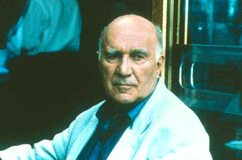 Manoel de Oliveira may be 92, but I'm Going Home, his latest film
reaffirms life as it looks in the face of death. The film opens with its lead
character, an actor named Gilbert Valence (Michel Piccoli), onstage, opposite
Catherine Deneuve, in a production of Ionesco's "Exit the King". We
see a good portion of this performance, as the scene lasts about fifteen
minutes. After the curtain call, we discover the actor's wife, daughter, and
son-in-law have been killed in a car crash, leaving his grandson orphaned. After
disclosing this information, the film leaps to "some time later."
Manoel de Oliveira may be 92, but I'm Going Home, his latest film
reaffirms life as it looks in the face of death. The film opens with its lead
character, an actor named Gilbert Valence (Michel Piccoli), onstage, opposite
Catherine Deneuve, in a production of Ionesco's "Exit the King". We
see a good portion of this performance, as the scene lasts about fifteen
minutes. After the curtain call, we discover the actor's wife, daughter, and
son-in-law have been killed in a car crash, leaving his grandson orphaned. After
disclosing this information, the film leaps to "some time later."