|
Newest Reviews:
New Movies -
The Tunnel
V/H/S
The Tall Man
Mama Africa
Detention
Brake
Ted
Tomboy
Brownian Movement
Last Ride
[Rec]³: Genesis
Hara-Kiri: Death of a Samurai
Indie Game: The Movie
Abraham Lincoln: Vampire Hunter
Old Movies -
Touki Bouki: The Journey of the Hyena
Drums Along the Mohawk
The Chase
The Heiress
Show
People
The Strange Affair of Uncle Harry
Pitfall
Driftwood
Miracle Mile
The Great Flamarion
Dark Habits
Archives -
Recap: 2000,
2001, 2002,
2003, 2004
, 2005, 2006,
2007 , 2008
, 2009 ,
2010 , 2011 ,
2012
All reviews alphabetically
All reviews by star rating
All reviews by release year
Masterpieces
Screening Log
Links
FAQ
E-mail me
HOME
| |
All or Nothing (Mike Leigh) 2002
 Returning back to modern day England after a jolly stint in
the past with Topsy Turvy, Mike Leigh slides back into comfortable
territory with his new film All or Nothing without sacrificing much of
the introspection or emotional wallop that has defined his previous efforts. If
this slightly slight movie doesn’t quite pack the punch of Leigh’s Secrets
& Lies or Life is Sweet it’s clearly leaps and bounds better
than something like Career Girls, which qualified as a miss for him. In
returning now to look at the woebegone working classes of Britain, he seems to
be implicitly arguing that even in a country well out of the Thatcher regime,
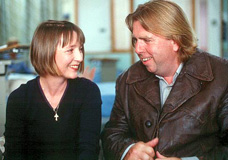
little has fundamentally changed for the masses. Centering on three families who
have neighboring homes in an apartment complex, the film shows that the ennui of
the working person (Leigh makes it very clear that to say “working man”
would be grossly inaccurate) is widespread and wearying. The first hour of All
or Nothing is a bit difficult to sit through because it places an evocation
of the characters’ outwardly mundane lives before any plot considerations.
These generally dysfunctional characters range from heartbreakingly meek to
frustratingly lazy, but before judging any of them, Leigh insists that the
film’s audience must understand the demoralizing and physically taxing toll of
work on these characters.
Returning back to modern day England after a jolly stint in
the past with Topsy Turvy, Mike Leigh slides back into comfortable
territory with his new film All or Nothing without sacrificing much of
the introspection or emotional wallop that has defined his previous efforts. If
this slightly slight movie doesn’t quite pack the punch of Leigh’s Secrets
& Lies or Life is Sweet it’s clearly leaps and bounds better
than something like Career Girls, which qualified as a miss for him. In
returning now to look at the woebegone working classes of Britain, he seems to
be implicitly arguing that even in a country well out of the Thatcher regime,
little has fundamentally changed for the masses. Centering on three families who
have neighboring homes in an apartment complex, the film shows that the ennui of
the working person (Leigh makes it very clear that to say “working man”
would be grossly inaccurate) is widespread and wearying. The first hour of All
or Nothing is a bit difficult to sit through because it places an evocation
of the characters’ outwardly mundane lives before any plot considerations.
These generally dysfunctional characters range from heartbreakingly meek to
frustratingly lazy, but before judging any of them, Leigh insists that the
film’s audience must understand the demoralizing and physically taxing toll of
work on these characters.
 Once All or Nothing’s context is established and
the plot kicks in, courtesy of a health crisis that tests the families’
ability to pull together, the pace kicks up considerably. Though the
socio-economic baggage built up in the first hour of the film is still somewhat
helpful here, it becomes a bit irrelevant as the dramas that unfold become more
universally accessible. Surely many of the insecurities that arise are closely
tied into the self-loathing that Leigh suggests comes about after spending years
in an unfulfilling job, but it’s still difficult to justify quite as much
observation of character as Leigh sees fit to include in the first hour. Nothing
included in the first half seems wrongheaded, and the cumulative impact is
undeniable, but the method of delivery is far from graceful, especially when
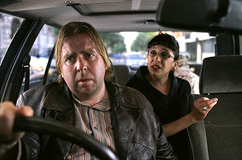
contrasted with the tighter second half. Isolated scenes, such as the one where
Timothy Spall’s cabbie drives out to a picaresque seashore (and seems
profoundly out of place) or the segments that show him conversing with a
particularily irascible passenger (Kathryn Hunter), are as good as anything Leigh’s done. He clearly hasn’t
lost his observational gifts, and it almost goes without saying when describing
a Mike Leigh film that the cast is uniformly stellar. Even as All or Nothing
doesn’t fail, it pales in comparison with the best of Leigh’s work, but all
the same it’s well worth seeing.
Once All or Nothing’s context is established and
the plot kicks in, courtesy of a health crisis that tests the families’
ability to pull together, the pace kicks up considerably. Though the
socio-economic baggage built up in the first hour of the film is still somewhat
helpful here, it becomes a bit irrelevant as the dramas that unfold become more
universally accessible. Surely many of the insecurities that arise are closely
tied into the self-loathing that Leigh suggests comes about after spending years
in an unfulfilling job, but it’s still difficult to justify quite as much
observation of character as Leigh sees fit to include in the first hour. Nothing
included in the first half seems wrongheaded, and the cumulative impact is
undeniable, but the method of delivery is far from graceful, especially when
contrasted with the tighter second half. Isolated scenes, such as the one where
Timothy Spall’s cabbie drives out to a picaresque seashore (and seems
profoundly out of place) or the segments that show him conversing with a
particularily irascible passenger (Kathryn Hunter), are as good as anything Leigh’s done. He clearly hasn’t
lost his observational gifts, and it almost goes without saying when describing
a Mike Leigh film that the cast is uniformly stellar. Even as All or Nothing
doesn’t fail, it pales in comparison with the best of Leigh’s work, but all
the same it’s well worth seeing.
* * * 1/2
10-21-02
Jeremy Heilman
|
