|
Newest Reviews:
New Movies -
The Tunnel
V/H/S
The Tall Man
Mama Africa
Detention
Brake
Ted
Tomboy
Brownian Movement
Last Ride
[Rec]³: Genesis
Hara-Kiri: Death of a Samurai
Indie Game: The Movie
Abraham Lincoln: Vampire Hunter
Old Movies -
Touki Bouki: The Journey of the Hyena
Drums Along the Mohawk
The Chase
The Heiress
Show
People
The Strange Affair of Uncle Harry
Pitfall
Driftwood
Miracle Mile
The Great Flamarion
Dark Habits
Archives -
Recap: 2000,
2001, 2002,
2003, 2004
, 2005, 2006,
2007 , 2008
, 2009 ,
2010 , 2011 ,
2012
All reviews alphabetically
All reviews by star rating
All reviews by release year
Masterpieces
Screening Log
Links
FAQ
E-mail me
HOME
| |
El Crimen del Padre Amaro (Carlos Carrera) 2002
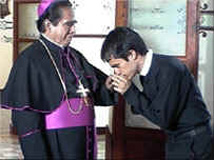 El Crimen del Padre
Amaro, Carlos Carrera’s limp attack on organized religion, is a soggy
melodrama that never builds its laundry list of wild incidents into something
that’s either emotionally engaging or a potent political attack. One can’t
help but wonder what all of the real-world fuss, which has lead to an insane
amount of controversy in the film’s native Mexico, is about, especially since
the source material for the picture is a novel that was written in 1875. Though
the movie deals with forbidden love, money laundering, drug dealing, abortion,
guerilla fighters and lapsed priests, there’s little that manages to titillate
or even come to life. The somber tone is rather surprising given the amount of
vindictiveness on display here, but it seems calculated so the movie’s
attempts to deride its targets can appear to be hard-won ones. Unfortunately, as
much as the film is to be commended for not sensationalizing things or bringing
up pedophilia, that scheme backfires, leaving a series of scenes that feel
boring, empty, and obvious.
El Crimen del Padre
Amaro, Carlos Carrera’s limp attack on organized religion, is a soggy
melodrama that never builds its laundry list of wild incidents into something
that’s either emotionally engaging or a potent political attack. One can’t
help but wonder what all of the real-world fuss, which has lead to an insane
amount of controversy in the film’s native Mexico, is about, especially since
the source material for the picture is a novel that was written in 1875. Though
the movie deals with forbidden love, money laundering, drug dealing, abortion,
guerilla fighters and lapsed priests, there’s little that manages to titillate
or even come to life. The somber tone is rather surprising given the amount of
vindictiveness on display here, but it seems calculated so the movie’s
attempts to deride its targets can appear to be hard-won ones. Unfortunately, as
much as the film is to be commended for not sensationalizing things or bringing
up pedophilia, that scheme backfires, leaving a series of scenes that feel
boring, empty, and obvious.
 There’s an a serious, unmistakably devout vibe running
throughout Crimen, but it seems to exist only so the filmmakers can
further how vile they think organized religion is. It seems too easy here to
suggest that faith and religion are entirely separate things, since there are
plenty of committed characters in the film that seem to have no problem with the
act of worshiping. Since the movie wants to align us with the charismatic and
sexy titular protagonist (Gael Garcia Bernal), it seems afraid to truly
criticize his actions. Everything that he or his fellow corrupt priests does, no
matter how reprehensible, is presented on terms that the audience could
sympathize with, but that ample justification sells the scale of their
transgressions short and undercuts the drama that should be inherent in the
movie. The sense of duty that he should feel toward his parishioners is not
stressed, and the ones that the audience gets to know the most are all about as
dastardly as the priests seem to be. There’s not really any soul searching
here, since the movie insists on appealing to the audience’s ability to
rationalize away the reasons behind the misdeeds that occur. When a young boy
asks the meaning of the word “fornicate” at one point, the movie expects us
to recoil at his temerity, almost to the point where it seems more ghastly than
anything the priests do, but I found myself far more disturbed by the inaccurate
answer offered to him (“It means to eat meat during the holy day.”) that his
honest question. El Crimen del Padre Amaro doesn’t seem to see the
hypocrisy in this moment, because it’s too busy attempting to manipulate us so
we giggle, and in that lack of clear-sightedness, it similarly fails when
attempting to show us its central moral dilemmas.
There’s an a serious, unmistakably devout vibe running
throughout Crimen, but it seems to exist only so the filmmakers can
further how vile they think organized religion is. It seems too easy here to
suggest that faith and religion are entirely separate things, since there are
plenty of committed characters in the film that seem to have no problem with the
act of worshiping. Since the movie wants to align us with the charismatic and
sexy titular protagonist (Gael Garcia Bernal), it seems afraid to truly
criticize his actions. Everything that he or his fellow corrupt priests does, no
matter how reprehensible, is presented on terms that the audience could
sympathize with, but that ample justification sells the scale of their
transgressions short and undercuts the drama that should be inherent in the
movie. The sense of duty that he should feel toward his parishioners is not
stressed, and the ones that the audience gets to know the most are all about as
dastardly as the priests seem to be. There’s not really any soul searching
here, since the movie insists on appealing to the audience’s ability to
rationalize away the reasons behind the misdeeds that occur. When a young boy
asks the meaning of the word “fornicate” at one point, the movie expects us
to recoil at his temerity, almost to the point where it seems more ghastly than
anything the priests do, but I found myself far more disturbed by the inaccurate
answer offered to him (“It means to eat meat during the holy day.”) that his
honest question. El Crimen del Padre Amaro doesn’t seem to see the
hypocrisy in this moment, because it’s too busy attempting to manipulate us so
we giggle, and in that lack of clear-sightedness, it similarly fails when
attempting to show us its central moral dilemmas.
* *
10-31-02
Jeremy Heilman
|
