|
Newest Reviews:
New Movies -
The Tunnel
V/H/S
The Tall Man
Mama Africa
Detention
Brake
Ted
Tomboy
Brownian Movement
Last Ride
[Rec]³: Genesis
Hara-Kiri: Death of a Samurai
Indie Game: The Movie
Abraham Lincoln: Vampire Hunter
Old Movies -
Touki Bouki: The Journey of the Hyena
Drums Along the Mohawk
The Chase
The Heiress
Show
People
The Strange Affair of Uncle Harry
Pitfall
Driftwood
Miracle Mile
The Great Flamarion
Dark Habits
Archives -
Recap: 2000,
2001, 2002,
2003, 2004
, 2005, 2006,
2007 , 2008
, 2009 ,
2010 , 2011 ,
2012
All reviews alphabetically
All reviews by star rating
All reviews by release year
Masterpieces
Screening Log
Links
FAQ
E-mail me
HOME
| |
American Splendor (Shari Springer Berman & Robert
Pulcini, 2003)
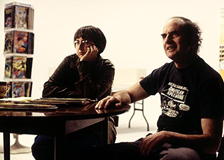 Casting itself at first as an antidote
to the overly sentimental strains of Hollywood melodrama, American
Splendor eventually succumbs to formula and a facile treatment of its
hero’s fight with cancer (think montage). Warning signs start to crop up
around midway through the film, when its curmudgeonly comic-book protagonist
Harvey Pekar (Paul Giamatti) meets his wife-to-be Joyce (Hope Davis). Suddenly
the film, which has up until that point somewhat inventively incorporated
documentary footage of the real-life Pekar and meta-moments that took care to
remind us that Giamatti’s fictionalized world isn’t to be mistaken for the
real thing, becomes a lot more conventional. Joyce and Harvey play cute for a
few scenes, acting like oddballs in a Cleveland that seems to be entirely
populated by oddballs. It’s worth noting that these scenes are probably the
most enjoyable in the film (they are the only ones that really strike a balance
between the cynical and maudlin), but they set a tone that doesn’t really fit
as the movie moves beyond their brief courtship and into more serious concerns
about their long-term viability and Harvey’s willingness to sell out as an
artist. Before long, American Splendor
blooms into a full-blown message movie with a cynical chaser that’s supposed
to make us forget the previous half-hour of corn. It expects us to buy precisely
the sort of uplift that Harvey so hilariously eviscerates about an hour later
after a screening of The Revenge of the
Nerds with one of that masterwork’s biggest fans. Casting itself at first as an antidote
to the overly sentimental strains of Hollywood melodrama, American
Splendor eventually succumbs to formula and a facile treatment of its
hero’s fight with cancer (think montage). Warning signs start to crop up
around midway through the film, when its curmudgeonly comic-book protagonist
Harvey Pekar (Paul Giamatti) meets his wife-to-be Joyce (Hope Davis). Suddenly
the film, which has up until that point somewhat inventively incorporated
documentary footage of the real-life Pekar and meta-moments that took care to
remind us that Giamatti’s fictionalized world isn’t to be mistaken for the
real thing, becomes a lot more conventional. Joyce and Harvey play cute for a
few scenes, acting like oddballs in a Cleveland that seems to be entirely
populated by oddballs. It’s worth noting that these scenes are probably the
most enjoyable in the film (they are the only ones that really strike a balance
between the cynical and maudlin), but they set a tone that doesn’t really fit
as the movie moves beyond their brief courtship and into more serious concerns
about their long-term viability and Harvey’s willingness to sell out as an
artist. Before long, American Splendor
blooms into a full-blown message movie with a cynical chaser that’s supposed
to make us forget the previous half-hour of corn. It expects us to buy precisely
the sort of uplift that Harvey so hilariously eviscerates about an hour later
after a screening of The Revenge of the
Nerds with one of that masterwork’s biggest fans.
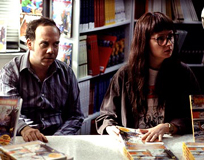 I suppose the growth that Harvey
exhibits during American Splendor is
preferable to a holding pattern that would have maintained the mood of his
introduction (a rather worrisome two-shot that equates the childhood Pekar who
grumbles to himself, “Everyone is stupid,” with the fully grown adult
version of the same), but it still feels like something of a con. Essentially
the movie asks us to celebrate Pekar for at least partially growing out of the
mood that we’re celebrating him for in the first place. Early on, the real
Pekar is asked by an off-screen narrator if he’s read the script to the movie.
He notes that he really hasn’t. I can’t imagine that if he lives up to the
persona that the movie presents, he’d be too thrilled with the results.
“I’m no show biz phony – I’m telling the truth,” Pekar protests during
a disastrous stint on the Letterman show, which still might be the case at the
film’s end, but if Pekar has reached the point where he thinks lazily observed
homilies are truth, why are we still listening to him? I suppose the growth that Harvey
exhibits during American Splendor is
preferable to a holding pattern that would have maintained the mood of his
introduction (a rather worrisome two-shot that equates the childhood Pekar who
grumbles to himself, “Everyone is stupid,” with the fully grown adult
version of the same), but it still feels like something of a con. Essentially
the movie asks us to celebrate Pekar for at least partially growing out of the
mood that we’re celebrating him for in the first place. Early on, the real
Pekar is asked by an off-screen narrator if he’s read the script to the movie.
He notes that he really hasn’t. I can’t imagine that if he lives up to the
persona that the movie presents, he’d be too thrilled with the results.
“I’m no show biz phony – I’m telling the truth,” Pekar protests during
a disastrous stint on the Letterman show, which still might be the case at the
film’s end, but if Pekar has reached the point where he thinks lazily observed
homilies are truth, why are we still listening to him?
44
09-20-03
Jeremy Heilman
|
