|
Newest Reviews:
New Movies -
The Tunnel
V/H/S
The Tall Man
Mama Africa
Detention
Brake
Ted
Tomboy
Brownian Movement
Last Ride
[Rec]³: Genesis
Hara-Kiri: Death of a Samurai
Indie Game: The Movie
Abraham Lincoln: Vampire Hunter
Old Movies -
Touki Bouki: The Journey of the Hyena
Drums Along the Mohawk
The Chase
The Heiress
Show
People
The Strange Affair of Uncle Harry
Pitfall
Driftwood
Miracle Mile
The Great Flamarion
Dark Habits
Archives -
Recap: 2000,
2001, 2002,
2003, 2004
, 2005, 2006,
2007 , 2008
, 2009 ,
2010 , 2011 ,
2012
All reviews alphabetically
All reviews by star rating
All reviews by release year
Masterpieces
Screening Log
Links
FAQ
E-mail me
HOME
| |
The Fog of War: Eleven Lessons Learned from the Life of
Robert S. McNamara (Errol Morris, 2003)
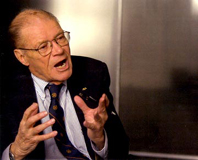 Perhaps the first thing that will strike
the viewer watching the new Errol Morris film is the verbosity of its title. The
Fog of War: Eleven Lessons Learned from the Life of Robert S. McNamara takes
the current trend of films with epic subtitles to new extremes, and not without
reason. Most of the film is comprised of an interview with former Secretary of
State McNamara, and divided into eleven chapters, each prefaced with a relevant
“lesson”. During each of these chapters, Morris includes his typical visual
flourishes and incorporates multimedia presentations of found footage from WWII
and the Vietnam War. Rather surprisingly, though, the imagery that Morris intercuts
with McNamara’s recollections with is almost always illustrative instead
of skeptical. The director allows McNamara to present himself as a numbers man
and an intellectual, and with that background established, McNamara begins to
justify all of his admittedly incorrect decisions. As a result, we get strange
juxtapositions such as the slick politician’s admission that he essentially
acted as a war criminal during the WWII bombings on Japan followed by
unsupported justification in which he claims in doing so he spared thousands of
Allied troops’ lives. It’s an intriguing approach, because it never
forcefully asks us to condemn McNamara, but it might not be enough for many. The
film plays like a confession without the admission of guilt. Though it would be
expecting a bit much to think McNamara would willingly reduce his place in
history or gaze at his life with a truly critical eye, many might argue that
Morris fails to fill this role when he doesn’t do so explicitly. Perhaps the first thing that will strike
the viewer watching the new Errol Morris film is the verbosity of its title. The
Fog of War: Eleven Lessons Learned from the Life of Robert S. McNamara takes
the current trend of films with epic subtitles to new extremes, and not without
reason. Most of the film is comprised of an interview with former Secretary of
State McNamara, and divided into eleven chapters, each prefaced with a relevant
“lesson”. During each of these chapters, Morris includes his typical visual
flourishes and incorporates multimedia presentations of found footage from WWII
and the Vietnam War. Rather surprisingly, though, the imagery that Morris intercuts
with McNamara’s recollections with is almost always illustrative instead
of skeptical. The director allows McNamara to present himself as a numbers man
and an intellectual, and with that background established, McNamara begins to
justify all of his admittedly incorrect decisions. As a result, we get strange
juxtapositions such as the slick politician’s admission that he essentially
acted as a war criminal during the WWII bombings on Japan followed by
unsupported justification in which he claims in doing so he spared thousands of
Allied troops’ lives. It’s an intriguing approach, because it never
forcefully asks us to condemn McNamara, but it might not be enough for many. The
film plays like a confession without the admission of guilt. Though it would be
expecting a bit much to think McNamara would willingly reduce his place in
history or gaze at his life with a truly critical eye, many might argue that
Morris fails to fill this role when he doesn’t do so explicitly.
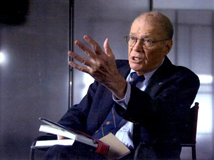 Morris rarely challenges his subject
directly during the interview process (and when he does, does it with a shout
from off screen). Combined with the structure of the film, which divides the film into segments,
each meant to impart one of McNamara’s “lessons”, this approach might make him feel too
sagelike for the film’s good. One could easily suggest that McNamara himself
has practiced nothing that he’s preached, and that the lessons are actually
the values by which we should judge the subject and come to the conclusion that
he’s lacking, but the passivity of the film makes it tough to commit to such a
view. I imagine such
contradictions would flit by the bulk of viewers, since to the somewhat passive
(or politically biased) viewer McNamara does indeed exhibit candor. At the start of the film, and
several times afterward, McNamara makes it clear to Morris and the audience that
he is participating in the interview as a chance to learn from his mistakes and
impart knowledge to the audience. One must wonder what percent of viewers will find it troubling when he doesn’t exhibit that kind of forthrightness at
every opportunity. It seems, perhaps, that Morris wants to make his audience think that
the more we hear about the situations the less we know about what really went
on. He titles his film after a passage in which McNamara suggests the scope
of war is so complex that no one man could ever take into account all of its
variables. When his film had ended, however, I was left feeling that the more I
heard from McNamara, the more I realized I wasn’t being told everything he
felt. While that might be Morris’ main point, it ends up making the The Fog
of War more about obstruction of the truth and the implied inadequacy of intellect
than a probe of the worthy subject that it examines. Morris makes a move into
the metaphorical and universal when specifics are what we want most. The mysterious, controversial figure
predictably reveals himself as a canny politician, using the cover
provided by his few truly confessional moments to mask a general unwillingness
to explore uncomfortable territory, and Morris doesn't try to get beyond that
exterior. Armchair philosophers might find some truths
about human nature in this bait and switch, but to this viewer it was mostly the
film's promises to stringently examine McNamara’s strategic decisions that left me
feeling slightly slighted. Morris rarely challenges his subject
directly during the interview process (and when he does, does it with a shout
from off screen). Combined with the structure of the film, which divides the film into segments,
each meant to impart one of McNamara’s “lessons”, this approach might make him feel too
sagelike for the film’s good. One could easily suggest that McNamara himself
has practiced nothing that he’s preached, and that the lessons are actually
the values by which we should judge the subject and come to the conclusion that
he’s lacking, but the passivity of the film makes it tough to commit to such a
view. I imagine such
contradictions would flit by the bulk of viewers, since to the somewhat passive
(or politically biased) viewer McNamara does indeed exhibit candor. At the start of the film, and
several times afterward, McNamara makes it clear to Morris and the audience that
he is participating in the interview as a chance to learn from his mistakes and
impart knowledge to the audience. One must wonder what percent of viewers will find it troubling when he doesn’t exhibit that kind of forthrightness at
every opportunity. It seems, perhaps, that Morris wants to make his audience think that
the more we hear about the situations the less we know about what really went
on. He titles his film after a passage in which McNamara suggests the scope
of war is so complex that no one man could ever take into account all of its
variables. When his film had ended, however, I was left feeling that the more I
heard from McNamara, the more I realized I wasn’t being told everything he
felt. While that might be Morris’ main point, it ends up making the The Fog
of War more about obstruction of the truth and the implied inadequacy of intellect
than a probe of the worthy subject that it examines. Morris makes a move into
the metaphorical and universal when specifics are what we want most. The mysterious, controversial figure
predictably reveals himself as a canny politician, using the cover
provided by his few truly confessional moments to mask a general unwillingness
to explore uncomfortable territory, and Morris doesn't try to get beyond that
exterior. Armchair philosophers might find some truths
about human nature in this bait and switch, but to this viewer it was mostly the
film's promises to stringently examine McNamara’s strategic decisions that left me
feeling slightly slighted.
54
12-25-03
Jeremy Heilman
|
