|
Newest Reviews:
New Movies -
The Tunnel
V/H/S
The Tall Man
Mama Africa
Detention
Brake
Ted
Tomboy
Brownian Movement
Last Ride
[Rec]³: Genesis
Hara-Kiri: Death of a Samurai
Indie Game: The Movie
Abraham Lincoln: Vampire Hunter
Old Movies -
Touki Bouki: The Journey of the Hyena
Drums Along the Mohawk
The Chase
The Heiress
Show
People
The Strange Affair of Uncle Harry
Pitfall
Driftwood
Miracle Mile
The Great Flamarion
Dark Habits
Archives -
Recap: 2000,
2001, 2002,
2003, 2004
, 2005, 2006,
2007 , 2008
, 2009 ,
2010 , 2011 ,
2012
All reviews alphabetically
All reviews by star rating
All reviews by release year
Masterpieces
Screening Log
Links
FAQ
E-mail me
HOME
| |
Japanese Story (Sue Brooks, 2003)
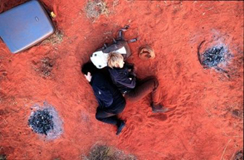 It’s probably best for any viewer to
see Sue Brooks’ twisty Japanese Story without
knowing anything about it in advance, with the possible exception that Toni
Collette gives yet another superb performance, demonstrating range that one
wouldn’t necessarily expect, given the material that she’s been presented
with. The film is blessed with a screenplay that keeps moving in unexpected
directions, with each new sequence belying the promise of what’s come before
without quite betraying it. It dredges up feelings that are later stymied by
unforeseen developments, but not forgotten, and as a result, the plot snowballs
into a surprising, but genuinely moving, denouement. Because of this, despite
its moment-to-moment directness, it presents a great challenge for its lead
actress to remain consistent in the many permutations her character is seen in.
Collette is required to be apathetic, astringent, amusing, anguished, and
alluring, and against the odds, never missteps. As it morphs from comedy of
manners to road movie to survivalist adventure to woman’s picture and beyond, Japanese
Story momentarily recalls both contemporary movies such as Gerry,
Twentynine Palms, and Lost
in Translation, and older fare like Walkabout
and Out of Africa, but ultimately is too idiosyncratic a contraption to
bear any direct comparisons. Needless to say, the movie is better for it, even
if the place where it finally lands might be a tad bit underwhelming (if
undeniably heartfelt). It’s probably best for any viewer to
see Sue Brooks’ twisty Japanese Story without
knowing anything about it in advance, with the possible exception that Toni
Collette gives yet another superb performance, demonstrating range that one
wouldn’t necessarily expect, given the material that she’s been presented
with. The film is blessed with a screenplay that keeps moving in unexpected
directions, with each new sequence belying the promise of what’s come before
without quite betraying it. It dredges up feelings that are later stymied by
unforeseen developments, but not forgotten, and as a result, the plot snowballs
into a surprising, but genuinely moving, denouement. Because of this, despite
its moment-to-moment directness, it presents a great challenge for its lead
actress to remain consistent in the many permutations her character is seen in.
Collette is required to be apathetic, astringent, amusing, anguished, and
alluring, and against the odds, never missteps. As it morphs from comedy of
manners to road movie to survivalist adventure to woman’s picture and beyond, Japanese
Story momentarily recalls both contemporary movies such as Gerry,
Twentynine Palms, and Lost
in Translation, and older fare like Walkabout
and Out of Africa, but ultimately is too idiosyncratic a contraption to
bear any direct comparisons. Needless to say, the movie is better for it, even
if the place where it finally lands might be a tad bit underwhelming (if
undeniably heartfelt).
 As Japanese
Story opens, sour geologist Sandy (Collette) is goaded into an agreement to
chauffer Hiro (Gotaro Tsunashima), the
Japanese son of a prospective investor, around the Australian outback on a trip
that seems to have no practical purpose. The first few scenes of the movie make
much of Sandy’s half-hearted efforts to bridge the cultural gap that exists
between her and Hiro, often to amusing effect. Reluctantly assigned as Hiro’s
driver and tour guide, Sandy makes a few stabs at connection with the man, but
treats their relationship as something to be endured. As they retreat further
the wilderness, their cultural misunderstanding of one another is only further
underscored. It’s at that point that the movie begins to take on more resonant
attitudes toward its subject matter. Their wildly different attitudes toward to
the land that they traverse and modes of crisis management they employ become
points of contention as events take a turn for the worse. The attitudes that
resulted in trivial annoyances between the two, such as his arrogance and her
ignorance of his ways, become obstacles to their survival and understanding of
one another as the stakes are raised on every level. By the end of its tale, Japanese
Story has outgrown its unassuming premise and taken the audience on an
emotional journey that is all the more affecting because of its serendipitous
nature. As Japanese
Story opens, sour geologist Sandy (Collette) is goaded into an agreement to
chauffer Hiro (Gotaro Tsunashima), the
Japanese son of a prospective investor, around the Australian outback on a trip
that seems to have no practical purpose. The first few scenes of the movie make
much of Sandy’s half-hearted efforts to bridge the cultural gap that exists
between her and Hiro, often to amusing effect. Reluctantly assigned as Hiro’s
driver and tour guide, Sandy makes a few stabs at connection with the man, but
treats their relationship as something to be endured. As they retreat further
the wilderness, their cultural misunderstanding of one another is only further
underscored. It’s at that point that the movie begins to take on more resonant
attitudes toward its subject matter. Their wildly different attitudes toward to
the land that they traverse and modes of crisis management they employ become
points of contention as events take a turn for the worse. The attitudes that
resulted in trivial annoyances between the two, such as his arrogance and her
ignorance of his ways, become obstacles to their survival and understanding of
one another as the stakes are raised on every level. By the end of its tale, Japanese
Story has outgrown its unassuming premise and taken the audience on an
emotional journey that is all the more affecting because of its serendipitous
nature.
66
Jeremy Heilman
01-05-04
|
