|
Newest Reviews:
New Movies -
The Tunnel
V/H/S
The Tall Man
Mama Africa
Detention
Brake
Ted
Tomboy
Brownian Movement
Last Ride
[Rec]³: Genesis
Hara-Kiri: Death of a Samurai
Indie Game: The Movie
Abraham Lincoln: Vampire Hunter
Old Movies -
Touki Bouki: The Journey of the Hyena
Drums Along the Mohawk
The Chase
The Heiress
Show
People
The Strange Affair of Uncle Harry
Pitfall
Driftwood
Miracle Mile
The Great Flamarion
Dark Habits
Archives -
Recap: 2000,
2001, 2002,
2003, 2004
, 2005, 2006,
2007 , 2008
, 2009 ,
2010 , 2011 ,
2012
All reviews alphabetically
All reviews by star rating
All reviews by release year
Masterpieces
Screening Log
Links
FAQ
E-mail me
HOME
| |
Flanders
(Bruno Dumont, 2006)
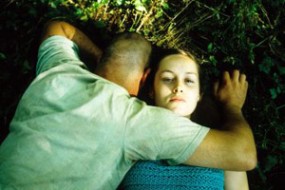
Bruno Dumont’s
Flanders offers what is
as close to a happy ending as we’ve seen from the director, but it’s hard won.
The first half hour of the film, set mostly on a rural Belgian farm during the
harsh autumn, depicts a of sort of idyllic severity. Dumont
uses this sequence to observe the sheer physicality of his onscreen world. The
actors communicate mostly through body language. He highlights the clumsiness of
his cast, the mechanics of farming, and the dampness of the climate. This
contrasts sharply with the scenes that follow, in which two men from the rural
region enlist in a military operation in a nonspecific foreign country. The
desert terrain they inhabit there is desolate and arid. It couldn’t be farther
from what they’ve come from. The enemies they face jabber at them, and it’s
immediately apparent from their bullying tactics that there will be no common
ground forged. What transpires instead is a series of bloody and brutal
sequences, that force the men to confront their savage instincts. As Dumont cuts
between their trials and the rapidly unraveling woman left behind at home, he
sets up parallels, such as those involving dual sexual indiscretions, that
wordlessly express the dissatisfaction and angst that the characters can’t quite
articulate.
The effect of this slim but forceful plot gives Flanders
the bluntness of a parable, a feeling that is only enhanced by the changing
seasonal backdrop that accompanies the passage of time in the story.
Dumont subtly turns his film into a larger statement about the
horrors of war and the role of gender in coping with it. Enough is left vague
that an abstract quality is achieved, and the effect is one of amplification of
the themes running throughout the film. It’s clear that despite the largely
sub-verbal rumblings of the characters, their spirituality is of prime concern.
Few directors are as willing as Dumont to
depict people who are not intelligent, and perhaps no one else is as convinced
as he that the possibility of their redemption demands attention. For every
moment of this minutely controlled film, Dumont
interrogates where they themselves do not.
76
Jeremy Heilman
01.03.08
|
