|
|
|
Newest Reviews: New Movies - Abraham Lincoln: Vampire Hunter Old Movies - Touki Bouki: The Journey of the Hyena The Strange Affair of Uncle Harry Archives - Recap: 2000, 2001, 2002, 2003, 2004 , 2005, 2006, 2007 , 2008 , 2009 , 2010 , 2011 , 2012
|
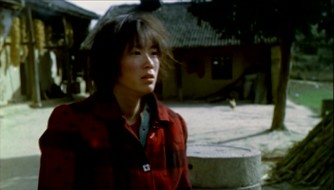
Blind Mountain (Li Yang, 2007)
Blind Mountain
the second film from fledgling Chinese filmmaker Li Yang, demonstrates many of
the same qualities that made his first,
Blind Shaft, one of the most promising directorial debuts of recent years.
Like its predecessor, Blind Mountain
is a realistic, documentary-style thriller that effectively dramatizes some of
the horrors of living in China’s politically unsettled, hopelessly corrupt
society. Set in 1991, the movie attacks the country’s tendencies toward both
collectivism and capitalism by chronicling the sordid saga of a young woman who
is drugged, abandoned, and sold into a life as the wife of a rural farmer who
lives in a town where such behavior is the accepted norm. Using an intimate
camera style, economic editing, and a clear focus on financial transactions,
Li’s approach decidedly begs comparison to that used by the Dardenne brothers.
He shares both their skill in maximizing the feeling of realism, even while
immersing the audience in the tension of a given moment, and their ability to
build an overall moral case through a slow, steady accumulation of incident.
The black humor that defined Blind Shaft
is largely absent this time around, but to
Blind Mountain’s credit it never
loses its jaundiced view toward China’s shortcomings in the way that the former
film did. Blind Mountain is bitter
fear mongering that sometimes leaves reason at the door in its attempt to
achieve effect. The one-note characterizations of the peasants, for example,
seem like a willful distortion of reality, even if they do allow the film to
operate more thoroughly as a horror story. Their intentions are as blatantly
nefarious as the scenery that surrounds them is beautiful. The script wastes no
time before they reveal their true colors to the hapless heroine. The effect of
such a one-sided approach, though, is a film that sacrifices some political
effectiveness for sheer emotional impact. In its alarmist, xenophobic
snobbishness, it’s only a stone’s throw away from questionable Western films
like Not Without My Daughter or
Deliverance.
That’s not to suggest that Blind Mountain
is anything less than absorbing as a viewing experience.
Li investigates this admittedly
melodramatic scenario in a manner that reduces its overtly political message,
opting instead to focus on the specifics of the character he’s chosen to follow.
As a chase film, it’s more effective than most, with the escape efforts of the
young captive constantly stymied by the villagers, who organize their efforts
against her with startling efficiency. Ultimately,
Blind Mountain’s worth lies in the
viewer’s willingness to set aside expectations of importance. Li Yang here
reveals himself to be a filmmaker who might be less aggressively cinematic and
less politically profound than his countryman Jia Zhang-ke, but also one who is
infinitely more approachable.
60
Jeremy Heilman
02.03.08
|