|
Newest Reviews:
New Movies -
The Tunnel
V/H/S
The Tall Man
Mama Africa
Detention
Brake
Ted
Tomboy
Brownian Movement
Last Ride
[Rec]³: Genesis
Hara-Kiri: Death of a Samurai
Indie Game: The Movie
Abraham Lincoln: Vampire Hunter
Old Movies -
Touki Bouki: The Journey of the Hyena
Drums Along the Mohawk
The Chase
The Heiress
Show
People
The Strange Affair of Uncle Harry
Pitfall
Driftwood
Miracle Mile
The Great Flamarion
Dark Habits
Archives -
Recap: 2000,
2001, 2002,
2003, 2004
, 2005, 2006,
2007 , 2008
, 2009 ,
2010 , 2011 ,
2012
All reviews alphabetically
All reviews by star rating
All reviews by release year
Masterpieces
Screening Log
Links
FAQ
E-mail me
HOME
| |
Persepolis
(Marjane Satrapi & Vincent Paronnaud, 2007)
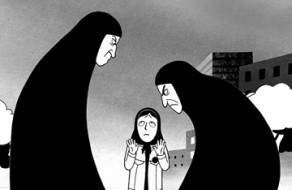
A confessional, imagination-laden memoir of life in Iran over the past few decades, Marjane Satrapi
and Vincent Paronnaud’s
Persepolis
quickly wears out its welcome. Adapted from Satrapi’s semi-autobiographical
graphic novel, the film can most be commended for retaining the comic book’s
original graphic style. In this animated feature, the sharp black and white
lines of pen on ink drawings is preserved, resulting in a relatively expressive
visual palette. The plot of the movie is considerably less inspired. It concerns
a young girl who comes of age as
Iran
passes from the Shah’s rule into an era of supposed freedom. Laced with
bitterness, the film at least starts with some discernible thesis, examining how
a girl channels her confusion caused by a world she couldn’t understand into
flights of fancy. In various scenes, she annoys her parents by defending the
Shah’s birthright, attacks a former friend whose father was found to be a
murderer, and renounces an avuncular God who she visualizes as her personal
playmate. By the time she grows to be an adult, though, and the movie
perplexingly continues to trudge onward, her tendency toward internalization
becomes downright disturbing, and the movie begins to feel remarkably
self-absorbed.
As
Persepolis
tries to adapt its freewheeling, fancy-free style to Satrapi’s very adult
problems, it begins to falter miserably. The bold, but plain, graphic design
which was initially enchanting, begins to wear on the eyes, since no new visual
tricks are revealed. One begins to wonder what the purpose is in showing that a
child can’t comprehend the political maneuverings that accompany a political
revolution if the adult that she’s become seems scarcely more savvy. Worse yet,
some of the boldest moments from the graphic novel (violent depictions of
torture, a brief stint as a drug runner, a suicide) have been excised here,
presumably making for easier audience consumption. The effect is the feeling
that we’re getting homogenized anecdotes instead of an unvarnished, warts and
all exploration of personal and national identity. With the political message of
Persepolis
considerably softened, the overall effect is dulled significantly. The film
ultimately comes off as a well-intentioned, but entirely superficial,
affirmation of our willingness to believe in universal blandness. Any
idiosyncratic impulses here begin and end with the movie’s visual stylization.
Any hard won personal insight Satrapi had to offer is squandered.
38
Jeremy Heilman
01.07.08
|
