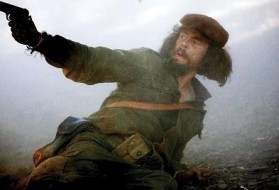
Che (Steven Soderbergh, 2008)

Nearly five hours in length and anchored by a lead
performance from Benicio Del Toro, Steven Soderbergh’s
Che looks from the outside like an
exciting epic about a charismatic revolutionary. In reality, it’s a demanding
work of cinematic structuralism that eschews most of the conventions of both the
war film and the biopic. In paring down his take on his controversial subject,
and in avoiding most of the simplistic political jingoism that would seem
inherent in such a project, Soderbergh probably cuts too close to the bone. His
film essentially presents only two extended, verite-style recreations of
Guevara’s Cuban and Bolivian insurgencies. What’s left is an exercise in formal
rigor that’s in the service of not much else. While the sheer idiosyncrasy of
Che makes it something of a must-see
work, it’s likely that Soderbergh’s approach will alienate the vast majority of
viewers.
Over two the halves of
Che, each shot in a different aspect
ratio with a distinct formal strategy, Soderbergh perversely minimizes our
ability to sympathize with, or even identify, most of his cast (Matt Damon,
however, is all too recognizable in his cameo). This simultaneously discourages
flag-waving and encourages audience apathy. The film becomes a scrupulous, but
close to pointless, study in guerilla warfare. The battles from the first film
are distractingly interrupted with context-setting voiceovers from an audio
interview and flashes forward to a U.N. session during which Che argues for
Cuba’s newfound “freedom”. In an
audience-punishing move, the first segment ends, just as Che is about to storm
into Havana,
stymieing any sense of victory. Then two hours of slow-burning defeat follow, as
the pompous Che turns up in Bolivia ready to attempt an impossible repeat
performance of his former glory.
The HD footage that Soderbergh
shot in the Bolivian jungles is gorgeous, and the perversity of so intricately
detailing an attempted revolution’s downward spiral is obvious, making the
second half considerably more intriguing than the first. Still, it’s tough to
imagine the movie appealing to anyone beyond the most ardent of art film
aficionados. The minimalist, anti-dramatic approach of
Che leaves so much unanswered, making
a perspective difficult to ascertain. Particularly frustrating for many will be
the fact that between the two halves of the movies, Soderbergh elides the
six-year period where Guevara’s takeover of Cuba
soured. Even ignoring such omissions, though, the film significantly fails on
its own terms in its final moments. As Guevara is dying, the camera suddenly
switches to a first-person perspective. A flashback, with Soderbergh’s trademark
pale blue and orange color scheme follows. In a film as controlled and
unsentimental until that point, this sudden effect of identification is
startling and hugely damaging to the overall integrity of the piece.
Nonetheless, Che is a movie that is
worth debating and revisiting. Its atypical approach ensures it a place in
cinematic history as a curio, at least.
50
07-17-08
Jeremy Heilman