|
Newest Reviews:
New Movies -
The Tunnel
V/H/S
The Tall Man
Mama Africa
Detention
Brake
Ted
Tomboy
Brownian Movement
Last Ride
[Rec]³: Genesis
Hara-Kiri: Death of a Samurai
Indie Game: The Movie
Abraham Lincoln: Vampire Hunter
Old Movies -
Touki Bouki: The Journey of the Hyena
Drums Along the Mohawk
The Chase
The Heiress
Show
People
The Strange Affair of Uncle Harry
Pitfall
Driftwood
Miracle Mile
The Great Flamarion
Dark Habits
Archives -
Recap: 2000,
2001, 2002,
2003, 2004
, 2005, 2006,
2007 , 2008
, 2009 ,
2010 , 2011 ,
2012
All reviews alphabetically
All reviews by star rating
All reviews by release year
Masterpieces
Screening Log
Links
FAQ
E-mail me
HOME
| |
Tokyo
Sonata (Kiyoshi Kurosawa, 2008)
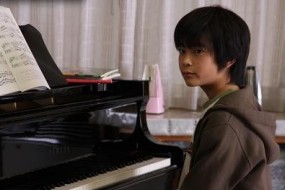 Japanese director Kiyoshi Kurosawa, known until this point exclusively as a
director of arty horror films, makes a major career detour with the family drama
Tokyo Sonata. With this sudden shift
in genre and ambition, though, he ends up delivering his best film yet. Telling
an ensemble tale about a family’s attempts to navigate the economic and social
landscape of modern-day Japan,
Sonata externalizes the stress that’s
inherent in keeping up appearances while under assault from all angles. The plot
gets set into motion as the father of the perfectly average Sasaki clan loses
his middle management position and begins wandering the streets, too ashamed to
tell his family that he’s been laid off. A salaryman without a salary, he soon
finds that his seemingly unique situation is, in fact, endemic. Similarly
dislocated unemployed workers populate the parks of the city, suggesting that
the malaise that afflicts the Sasakis extends to all of Japanese society.
Certainly the mother and son in the Sasaki family are not immune to the same
latent, but unmistakable and unsettled feelings of loneliness and inadequacy.
Mama Sasaski feels invisible in her own household, and Kenji, one of their sons,
grows further alienated from his parents as they refuse to embrace his burning
desire to take up piano lessons. A distinct discord is present in the family’s
earliest interactions, and it only grows stronger as the film continues.
Japanese director Kiyoshi Kurosawa, known until this point exclusively as a
director of arty horror films, makes a major career detour with the family drama
Tokyo Sonata. With this sudden shift
in genre and ambition, though, he ends up delivering his best film yet. Telling
an ensemble tale about a family’s attempts to navigate the economic and social
landscape of modern-day Japan,
Sonata externalizes the stress that’s
inherent in keeping up appearances while under assault from all angles. The plot
gets set into motion as the father of the perfectly average Sasaki clan loses
his middle management position and begins wandering the streets, too ashamed to
tell his family that he’s been laid off. A salaryman without a salary, he soon
finds that his seemingly unique situation is, in fact, endemic. Similarly
dislocated unemployed workers populate the parks of the city, suggesting that
the malaise that afflicts the Sasakis extends to all of Japanese society.
Certainly the mother and son in the Sasaki family are not immune to the same
latent, but unmistakable and unsettled feelings of loneliness and inadequacy.
Mama Sasaski feels invisible in her own household, and Kenji, one of their sons,
grows further alienated from his parents as they refuse to embrace his burning
desire to take up piano lessons. A distinct discord is present in the family’s
earliest interactions, and it only grows stronger as the film continues.
The underlying anxieties that fester
throughout the first half of Tokyo Sonata
manifest themselves in the second, through a series of subtly exaggerated,
almost phantasmagoric, encounters that see the family placed in one improbable
scenario after another, challenging and mocking their continued decorum. An
unlikely kidnapping, an automobile accident, and an entry into military service
expand the film’s emotional range and create palpably alien territory for
Kurosawa to explore. It’s here, as the family’s lives threaten to unravel, that
Kurosawa’s past as a director of scary movies pays the greatest dividends. He’s
able to create a pervasive sense of unease, even as he sets up the film’s
frequent comic moments, which often come at the expense of the hapless
protagonists. The air of anxiety that floats throughout
Tokyo Sonata ensures that when the
film’s redemptive but ambivalent ending finally arrives, it feels like a
genuinely cathartic sidestepping of the nuclear family’s inevitable extinction.
63
Jeremy Heilman
08.19.08
|
